
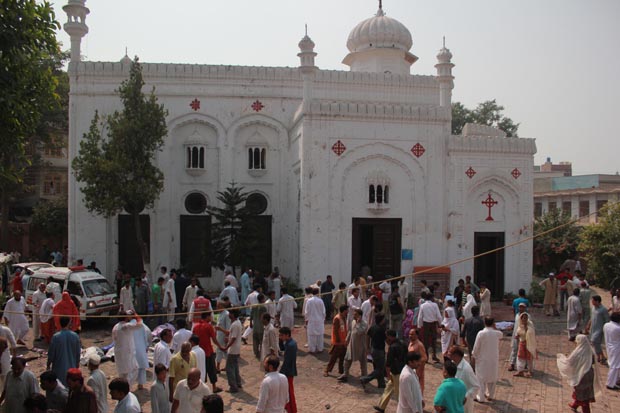
LAHORE, PUNJAB: Pakistan’s history of terrorist attacks against Christians and Christian places of worship has raised continuing concerns abo
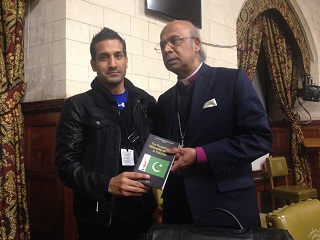
Wilson Chowdhry presents Bishop Michael BPCA first publication "The targeting of Minority Others' in Pakistan
London: February 11, 2015. (PCP) Religious freedom in Pakistan was highlighted as a serious concern, during a series of talks at the Grand Committee Room in the House of Commons last night.
The meeting which was co-ordinated by MP Rehman Chisti included Anglican Bishop Emeritus Michael Nazir Ali, Chair of the All Party Parliamentary Group on Religious Freedom Baroness Berridge and former High Commissioner for Pakistan Wajid Shamshul Hasan.
Bishop Michael explained within the Quran there is no validity for a blasphemy law, as no scripture supports it, he said; "there is no law for a blasphemy in the Quran."
Reflecting on the story of Kab ibn Ashraf a Jewish leader who was killed in 624 after the battle of Badr, on the order of Islamic prophet Muhammed, he explained that although many Islamic scholars use this as a tool for justifying blasphemy laws for all intents and purposes the reason for his death was sedition.
Bishop Michael further elaborated how Sheikh Ali Gomaa the former Grand Mufti of Egypt, tried to shepherd his followers away from blasphemy laws, by stating publicly "There is no punishment for blasphemy in this life." Bishop Michael challenged people to think about the common truth that any sensible believer in a God who is omnipotent has to admit. God does not need man to protect him; he is quite capable of looking after himself. Yes there may be a punishment in the afterlife but it will be God who is the final judge, jury and executioner. Remembering innocent Christian mother of five Asia Bibi. he expressed a lack of sanguine, which the Supreme Court of Pakistan would set her free, suggesting it might take a presidential pardon. Former High Commissioner Wajid Shamsul Hasan riposted "If he is brave enough!" A view which is unfortunately shared by many of us...
The Declaration of Human Rights of 1948 that was written in the post-war era when nations had reached a point of deep reflection sets the tone for human rights in western nations. Article 18 states;
"Everyone has the right to freedom of thought, conscience and religion; this right includes freedom to change his religion or belief, and freedom, either alone or in community with others and in public or private, to manifest his religion or belief in teaching, practice, worship and observance."
Bishop Michael explained that this article was rarely accepted in the Islamic sphere and that the act is either materially altered, agreed with for as long as it complies with Sharia Law or rejected. Subsequently the Cairo Declaration on Human Rights in Islam provides an overview of the Islamic view of human rights.
Baroness Berridge spoke of the work of the All Parliamentary Party Group on Religious freedom, whose role it is to highlight Religious Freedom or belief as a human right, within UK Parliament, media and general public . She shared details for the group’s website where information and support could be sought.
She shared major concerns that "76% of the world's population are living under high legal authority with respect to religious freedom." Pakistan was said to be one of the countries within which the relationship between one faith and overall governance had resulted in community schism and greater social polarity. They and we culture had developed that had broken down the common human bond.
Baroness Berridge reminded visitors that it was still illegal for Catholics to marry our monarch and that Britain only dropped their own blasphemy law in 2008, although use of the law had been extremely mild for many years. She felt that in due course and with a strong effort existing fanaticism in Pakistan could be curtailed.
Wajid Shamsul Hasan the former High Commissioner of Pakistan shared his belief that the case of Asia Bibi is not one of a blasphemy, but one of untouchability. he felt that it was more a consequence of her caste then her faith, a principle not shared by the British Pakistani Christian Association. Which Wilson later referred to during the Q&A session. Asia Bibi had a blasphemy charge laid against her not because she was beaten after drinking from the same well as Muslim's, but because when provoked through insults to Jesus and Christianity (not her caste I must reiterate), she simply uttered the words "My Christ died for me, what did Muhammed do for you?"
At this point Bishop Michael Thanked the BPCA for their recent Interview with the family of Asia Bibi. He did not realize that in a roundabout way he was actually also thanking the BPCA who facilitated the interview and challenged the BBC to contact the family.
Mr Hasan did however redeem himself that the concept of untouchability itself was not Islamic and should not be condoned in any way. He described a belief that the country had been hijacked by extremists and that change would not be overnight but a gradual and long fought process. He candidly stated; "The blasphemy law of Pakistan is defective it should be scrapped!" Explaining that the founder of Pakistan was a pluralist he quoted to some extent the words spoken at the the first Constituent Assembly of Pakistan;
"You are free; you are free to go to your temples, you are free to go to your mosques or to any other place or worship in this State of Pakistan. You may belong to any religion or caste or creed -- that has nothing to do with the business of the State"
Mr Shamsul Hasan, said; “Jinnah's concept of life was secular."
Rubab Mehdi Rizvi former European Spokesperson for the Ministry of Human Rights in Pakistan shared grave concerns about the rise in madrassas in Pakistan, during the Q & A session. She believed they were being used a tool for the spread of hatred.
Wilson Chowdhry went further describing the United States Commission for International Religious Freedom, analyses of curriculum text books in Pakistan. Wilson explained that these books demonized and caricatured minorities and that text books were deficient of any contribution made by minorities to the development and creation of Pakistan. He described the stalemate in the Punjab province assembly vote for joining Pakistan. The decision then became one for the speaker of the house a Christian MP, Mr S P Singha. His vote was pivotal in the viability of a nation as the Punjab is 75% of the land mass of the nation of Pakistan. No historical record or account of this is mentioned in any text book of Pakistan. Wilson Chowdhry said;
"The blotting out of a group or cultures contribution to society is a common way to undervalue their worth. This creates low self-esteem within the target group which inevitably reduces their progress and makes them more prone to bullying, harassment and discrimination, often bereft of the confidence, fortitude or ability to speak out for them. A classic example of this is the Christian community of Pakistan."
Pakistani reporter Esther Das said; "Every time we have these discussions Islamic apologists tell us that Islam does not preach hatred or the blasphemy law. If this is the case then who does?"
She added;
"If Islam is a religion of peace then why is there not more effort being made to change the current culture in Pakistan, by its religious leaders?"
You May Also Like
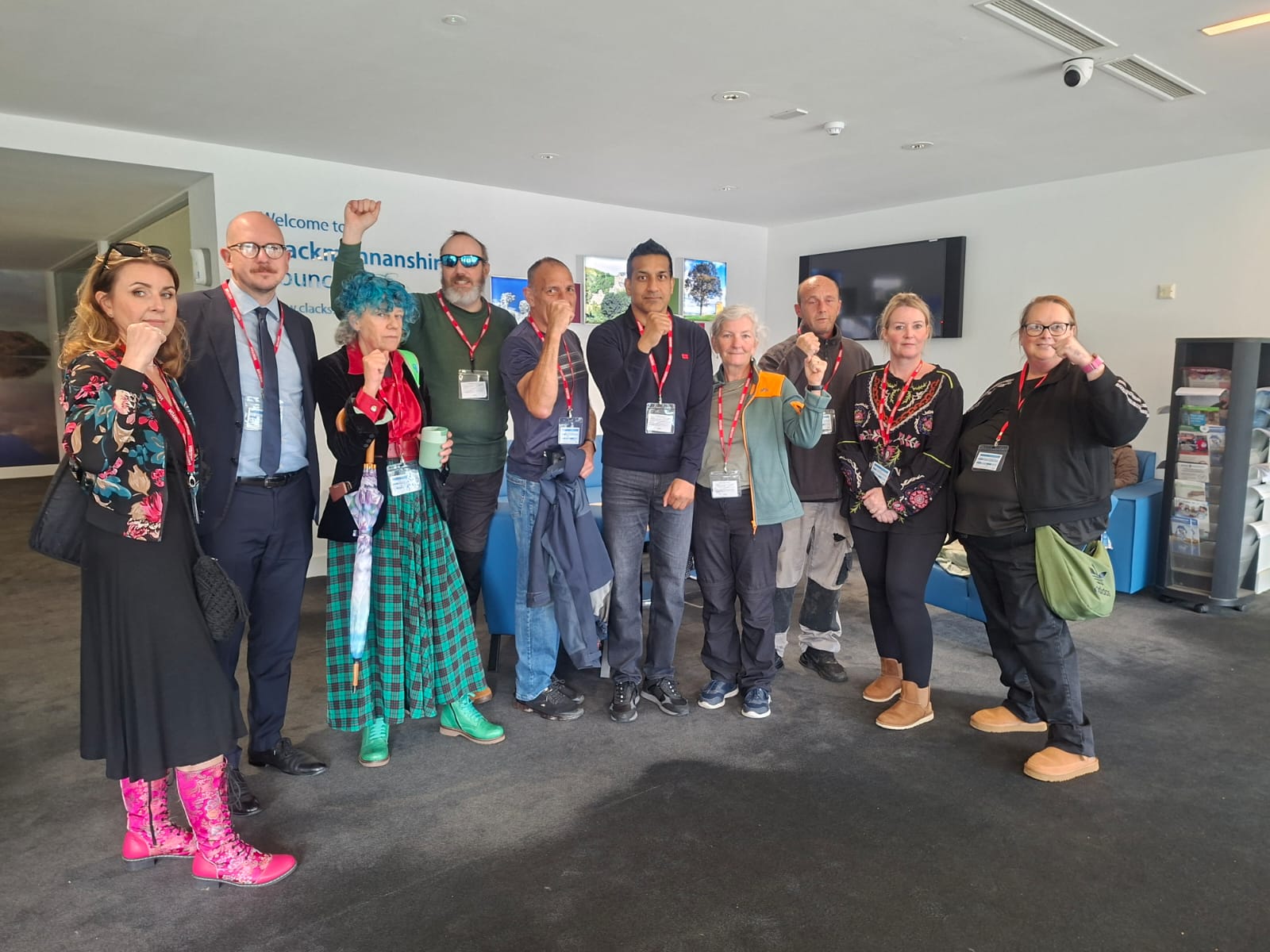
UK: RAAC homeowners in Tillicoultry are formally complaining to Clackmannanshire Council after continuing uncertainty over VAT, financial assistanc

KAMOKE, PUNJAB: Calls for truth, transparency and accountability are growing following the death of David Masih, a young Christian man from Kamoke


PCP need your support that we may provide you better services: click on donate


"Trial of Pakistani Christian Nation" By Nazir S Bhatti
On demand of our readers, I have decided to release E-Book version of "Trial of Pakistani Christian Nation" on website of PCP which can also be viewed on website of Pakistan Christian Congress www.pakistanchristiancongress.org . You can read chapter wise by clicking tab on left handside of PDF format of E-Book.