

Ferozewala, Punjab, Pakistan: BACA’s legal team has filed a post-arrest bail application for Christian man Kamran Masih, who was arrested fol
Religious Protection for All or Selective Justice? Sardar Mushtaq Gill Questions Pakistan’s Judiciary Over Unequal Protection of Islamic and Christian Religious Sanctities
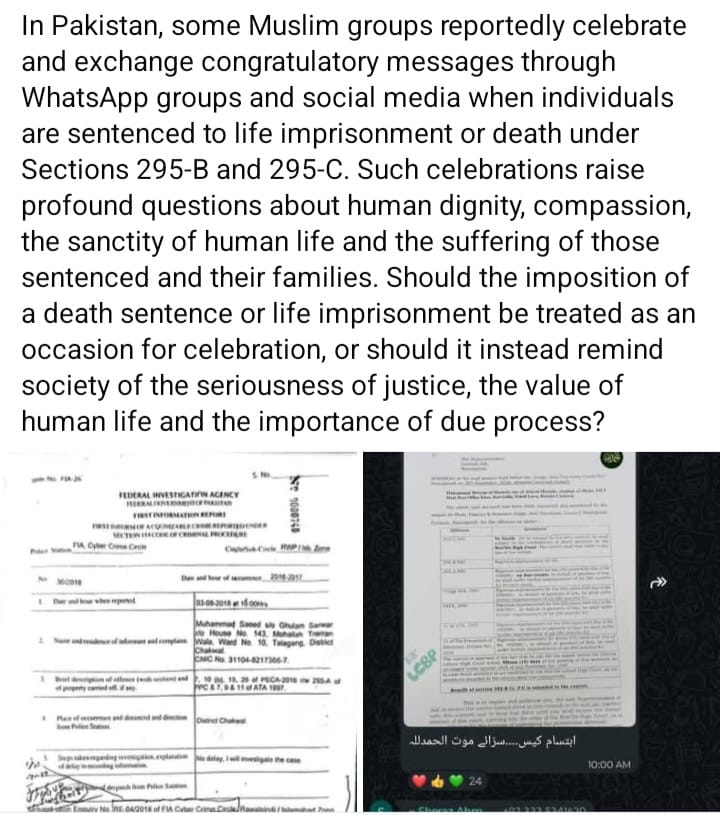
Rawalpindi, Pakistan: RELIGIOUS PROTECTION FOR ALL OR SELECTIVE JUSTICE? Sardar Mushtaq Gill, Human Rights Defender and Lawyer, raises serious human rights and constitutional questions following the reported Rawalpindi judgment sentencing Ibtisam Al-Mustafa to death in a case involving alleged offences concerning Islam, Christianity, Hinduism and Jesus Christ. He questions why Sections 295-B and 295-C of Pakistan's Penal Code specifically protect the Holy Quran and Prophet Muhammad (PBUH), while the Holy Bible, the Gospel and Jesus Christ have no equivalent religion-specific statutory protection. Challenging those who celebrate harsh punishments under blasphemy laws, Gill asks: What would happen if the same laws and punishments were applied to followers of all Islamic sects and schools of thought, including Sunni, Shia and Ahmadi Muslims, as well as their religious clerics and preachers, who openly and without hesitation describe Christian beliefs as false, challenge Christian doctrines, or make negative and derogatory statements about the Holy Bible, the crucifixion of Jesus Christ and other fundamental Christian beliefs during television programmes, public debates, sermons in mosques, and discussions in schools, colleges and universities? He does not endorse the death penalty or life imprisonment, nor does he advocate extending such severe punishments to anyone. Rather, his purpose is to expose the consequences of selective legal protection and challenge society to reconsider demands for harsh religious laws that may ultimately create suffering, injustice and legal consequences for people of all religious communities. Religious equality does not mean multiplying harsh punishments; it means protecting everyone's religious freedom, human dignity, freedom of expression and right to justice without discrimination.
A reported judgment delivered by Judge Syed Amjad Ali Shah of Anti-Terrorism Court No. 1, Rawalpindi, on 20 November 2026, sentencing Ibtisam Al-Mustafa to death, along with additional prison sentences and fines, in a case involving alleged derogatory and blasphemous content published on Facebook concerning Islam, Christianity, Hinduism and Jesus Christ, has raised important questions about religious freedom, minority rights and equality before the law in Pakistan. The case originated from a complaint filed by Muhammad Saeed with the Cyber Crime Department on 13 July 2017, following which FIR No. 36 was registered on 3 August 2018 at the FIA Cyber Crime Circle, Rawalpindi.
Sardar Mushtaq Gill, a Christian Human Rights Defender and Lawyer, has expressed serious reservations about presenting this judgment as evidence that Pakistan’s judicial system provides equal protection to the religious sentiments of Muslims, Christians and Hindus.
Gill makes it clear that merely mentioning Christianity and Hinduism alongside Islam in a criminal judgment does not establish that these religious communities enjoy equal statutory protection.
He questions whether the inclusion of Christianity and Hinduism in the reported judgment represents genuine judicial commitment to religious equality or simply diplomatic language intended to portray the judgment as an example of impartial protection of all religions.
According to the complainant's account, the court-imposed punishments relating to alleged offences involving Islam, the Holy Quran, Prophet Muhammad (PBUH), Christianity, Hinduism and Jesus Christ.
However, Gill argues that the real test of judicial impartiality is whether Christians and Hindus receive meaningful legal protection when their own sacred beliefs, scriptures, religious figures and identities are attacked.
The central question is: If Pakistan’s judiciary and criminal justice system consider the protection of Islamic religious sanctities important enough to warrant specific criminal provisions carrying life imprisonment and the death penalty, are they equally prepared to protect the religious sanctities of Christianity and Hinduism?
The Unequal Statutory Protection: Sections 295-B and 295-C
One of the principal concerns raised by Gill relates to the structure of Pakistan's blasphemy legislation, particularly Sections 295-B and 295-C of the Pakistan Penal Code.
Section 295-B specifically criminalises the wilful defilement, damage or desecration of a copy of the Holy Quran or an extract from it, or its use in a derogatory manner or for an unlawful purpose. The prescribed punishment is life imprisonment.
Section 295-C concerns words, written statements, visible representations, imputations, innuendos or insinuations, directly or indirectly, that defile the sacred name of Prophet Muhammad (PBUH). The prescribed punishment is death and a fine.
Gill questions why the law specifically identifies and protects the Holy Quran and Prophet Muhammad (PBUH), while the Holy Bible, the Gospel and Jesus Christ do not receive equivalent, religion-specific statutory protection under these provisions.
He asks:
If the deliberate and wilful desecration of the Holy Quran is punishable with life imprisonment under Section 295-B, why is there no equivalent provision specifically protecting the Holy Bible and Gospel?
If Section 295-C provides the death penalty for conduct defined in relation to the sacred name of Prophet Muhammad (PBUH), what equivalent provision specifically protects Jesus Christ, whose personality and religious significance are central to Christianity?
Does this difference reflect an unequal recognition of religious sanctity within Pakistan's criminal legislation?
Gill argues that the judiciary and Parliament must address this question through the constitutional principles of equality, religious freedom and minority protection.
Seven Questions Concerning the Protection of Christian Religious Sanctities
Gill has raised the following questions for the Pakistani judiciary, Parliament, government institutions and human rights organisations.
1. Protection of the Holy Bible and Gospel
If the wilful desecration or derogatory use of the Holy Quran attracts life imprisonment under Section 295-B, what equivalent specific statutory protection is available when someone deliberately and wilfully desecrates, damages or uses the Holy Bible or Gospel in a derogatory manner?
Why should Christian sacred scriptures not receive equivalent statutory recognition and protection?
2. Protection of Jesus Christ and His Sacred Name
If Section 295-C specifically protects the sacred name of Prophet Muhammad (PBUH) through a provision carrying the death penalty, what equivalent provision specifically protects Jesus Christ?
Will the judiciary recognise that Jesus Christ is central to Christian religious identity, faith and worship?
Why does Pakistan's criminal legislation not provide equivalent, specifically identified statutory protection for the sacred personality of Jesus Christ?
3. Protection of the Christian Belief in the Crucifixion and Resurrection
The crucifixion, death and resurrection of Jesus Christ are foundational Christian beliefs.
If statements or expressions concerning Islamic religious doctrines can attract criminal prosecution under applicable blasphemy provisions, will comparable expressions deliberately attacking the crucifixion and resurrection of Jesus Christ receive equivalent legal consideration?
Will the judiciary apply consistent standards when examining complaints involving the fundamental religious beliefs of Christians?
4. Protection Against Deliberate Insults to the Holy Bible and Christian Doctrine
What legal protection is available when individuals deliberately describe the Holy Bible and Gospel as fabricated, corrupted or fraudulent with the intention of humiliating Christians and outraging their religious sentiments?
Will Pakistani authorities examine such conduct under Section 295-A when its legal requirements are satisfied?
If the law recognises the importance of protecting the Holy Quran against derogatory treatment, why should Christian sacred scriptures not receive comparable consideration?
5. Protection Against the Use of ‘Chuhra’ as a Derogatory Expression
The use of the term ‘Chuhra’ as a caste-associated insult against Christians raises serious concerns about religious discrimination, social exclusion and human dignity.
Will Pakistani law enforcement agencies and courts take meaningful action against those who deliberately use this expression to humiliate Christians because of their religious identity and community background?
Will Christians receive equal protection against degrading and discriminatory treatment?
6. Protection Against Derogatory Statements Concerning Jesus Christ
Christianity and Islam have different theological understandings of Jesus Christ.
Christians believe in His divine identity, crucifixion and resurrection, while Islamic theology recognises Jesus as a revered prophet and discusses His return.
Gill questions whether statements deliberately intended to insult, degrade or humiliate Jesus Christ, His personality and His religious status in Christian theology will receive the same seriousness of legal examination as comparable statements concerning Islamic religious figures.
He also raises questions about derogatory expressions concerning the return of Jesus Christ and the Christian understanding of the Messiah.
The judiciary must explain whether comparable conduct is examined under consistent legal standards.
7. Protection of the Entire Christian Belief System
Will Pakistan's judiciary provide effective protection when Christian beliefs concerning the Holy Trinity, salvation through Jesus Christ, the Gospel, Christian worship and religious traditions are deliberately attacked through conduct that violates applicable laws?
If particular attacks against Islamic religious beliefs attract criminal prosecution, will comparable conduct involving Christian religious beliefs receive equivalent legal consideration?
Gill maintains that equal protection must be demonstrated through actual legal practice, not simply through references to Christianity in judgments.
The Constitutional Question: Equality Before the Law
Gill’s concerns are also grounded in Pakistan’s constitutional framework.
Article 20: Protects the freedom to profess, practise and propagate religion, subject to constitutional limitations.
Article 25: Guarantees equality before the law and equal protection of the law.
Article 36: Directs the State to safeguard the legitimate rights and interests of minorities.
Furthermore, Section 295-A of the Pakistan Penal Code addresses deliberate and malicious acts intended to outrage the religious feelings of any class of citizens by insulting its religion or religious beliefs. Section 298 addresses deliberately wounding the religious feelings of any person.
However, Gill highlights that these general provisions are not identical to Sections 295-B and 295-C.
The distinction is significant: Sections 295-B and 295-C specifically identify Islamic sacred objects and a religious personality, prescribing exceptionally severe punishments for the conduct defined in those provisions.
By comparison, Christians seeking protection for the Holy Bible, Gospel and Jesus Christ must rely on other applicable provisions, depending on the circumstances and legal elements of the alleged offence.
Gill therefore calls for an examination of whether this difference in statutory recognition is compatible with Pakistan's constitutional commitment to equality and religious freedom.
Is the Rawalpindi Judgment an Example of Equal Religious Protection?
Gill questions the manner in which the reported Rawalpindi judgment is being presented as a decision protecting the sentiments of three religions.
He argues that the inclusion of Christianity and Hinduism in the reported sentencing details cannot, by itself, establish equal treatment.
If the judiciary considers Christianity and Hinduism sufficiently important to invoke them in a criminal judgment, it must also demonstrate its commitment when Christians and Hindus approach the courts seeking protection for their own sacred scriptures, religious figures and fundamental beliefs.
The judiciary must demonstrate that religious complaints are investigated impartially, considered under the appropriate legal provisions and decided according to the applicable standards of evidence and due process.
The protection of Islamic religious sanctities should not be questioned or weakened. However, the protection of Christian and Hindu religious sanctities should not remain merely symbolic.
A Call to the Chief Justice, Parliament and Human Rights Institutions
Sardar Mushtaq Gill calls upon the Chief Justice of Pakistan, the superior judiciary, Parliament, the Ministry of Human Rights, the National Commission for Human Rights and the National Commission for Minorities to address these concerns.
He urges the relevant institutions to examine:
Why Sections 295-B and 295-C specifically identify the Holy Quran and Prophet Muhammad (PBUH), without equivalent religion-specific provisions for the Holy Bible, Gospel and Jesus Christ.
Whether Parliament should consider equivalent statutory protection for the sacred scriptures and religious figures of other religious communities.
Whether existing provisions, particularly Sections 295-A and 298, are applied impartially when Christians report attacks on their religious sentiments.
Whether complaints involving deliberate religious humiliation and discrimination against Christians receive the same seriousness as comparable complaints involving Muslims.
Whether the constitutional guarantee of equal protection is reflected in actual investigations, prosecutions and judicial decisions.
International Recognition of Christianophobia and Equal Legal Protection
Sardar Mushtaq Gill also calls upon the United Nations, international human rights organisations and the international community to strengthen the recognition of Christianophobia and translate that recognition into effective legal protection for Christians worldwide.
He argues that if Islamophobia receives international recognition and institutional attention, Christianophobia must also receive comparable attention, particularly regarding deliberate hatred against Christians, attacks on the Holy Bible and Gospel, insults against Jesus Christ, religious discrimination and attempts to intimidate Christians or undermine their religious identity and faith.
Gill urges governments, including Pakistan, to establish effective legal safeguards against deliberate and malicious attacks on Christian religious sentiments, sacred scriptures and religious figures, with appropriate remedies and accountability under clearly defined laws.
He points out that UN General Assembly Resolutions 76/254 (2022) and 78/212 already expressly recognise Christianophobia alongside other forms of religious intolerance. He therefore calls for this recognition to be translated into practical legislation, monitoring, protection and access to justice.
Equal Religious Protection Must Be More Than Diplomatic Language
The concerns raised by Sardar Mushtaq Gill are not an endorsement of the reported Rawalpindi judgment. Nor do they represent opposition to the protection of Islamic religious beliefs.
Rather, they constitute a human rights challenge concerning the consistency of Pakistan’s legal framework and the practical protection of religious minorities.
The central issue is whether Pakistan’s criminal justice system recognises the religious sanctity of different communities with equal seriousness.
If the Holy Quran and Prophet Muhammad (PBUH) receive specific statutory protection carrying life imprisonment and the death penalty, the question of equivalent statutory recognition for the Holy Bible, Gospel and Jesus Christ deserves serious legislative and constitutional consideration.
The judiciary cannot establish equal religious protection merely by mentioning Christianity and Hinduism in a judgment. Equality must be demonstrated when Christians and Hindus seek justice for violations of their own religious rights.
The credibility of Pakistan’s commitment to religious freedom will ultimately be measured by whether every religious community can approach the justice system with confidence that its sacred beliefs, religious identity and human dignity will receive fair and effective protection.
Gill Clarifies His Position: Equal Protection Does Not Mean Endorsing Harsh Punishments
Sardar Mushtaq Gill makes it unequivocally clear that his demand for equal statutory protection of Christian religious sentiments must not be interpreted as an endorsement of the death penalty or life imprisonment for alleged offences against religion. He does not celebrate or advocate such harsh punishments. His comparison is intended to expose the serious implications of extending similarly severe legal provisions to Christianity. He argues that if equivalent provisions were introduced to protect Christian beliefs, the same legal standards could also affect Muslims who routinely, openly and sometimes aggressively make negative or derogatory statements about Christianity, Christian doctrines, the crucifixion of Jesus Christ and other fundamental Christian beliefs. This raises an important question about the consequences of using criminal law to punish religious expression and theological disagreement.
Gill emphasises that the protection of religious sentiments must never become an excuse for unnecessary suffering, the destruction of human lives or the punishment of peaceful theological disagreement. Religious freedom, human dignity, freedom of expression, fair trials and due process must remain central to any legal framework.
His argument is therefore not that Christians should be subjected to the same harsh punishments imposed under Sections 295-B and 295-C, but that Christians must enjoy equal recognition, dignity and meaningful legal protection without endorsing disproportionate or inhumane penalties.
Religious freedom must be universal. Legal protection must be impartial. Human life and dignity must never become secondary to religious or political interests.
You May Also Like

Sindh, Pakistan: A devastating fire has destroyed the homes and belongings of three impoverished families—one Christian and two Hindu—i

Reddish, Stockport, United Kingdom: Reform UK has officially announced the selection of Adan Farhaj as its prospective council candidate for the Re


PCP need your support that we may provide you better services: click on donate


"Trial of Pakistani Christian Nation" By Nazir S Bhatti
On demand of our readers, I have decided to release E-Book version of "Trial of Pakistani Christian Nation" on website of PCP which can also be viewed on website of Pakistan Christian Congress www.pakistanchristiancongress.org . You can read chapter wise by clicking tab on left handside of PDF format of E-Book.