

Nigeria is preparing to take centre-stage in the global fight against drug resistance or antimicrobial resistance (AMR), with the Federal Governmen
On War: The Last Quiet Room. By Gregg Roman
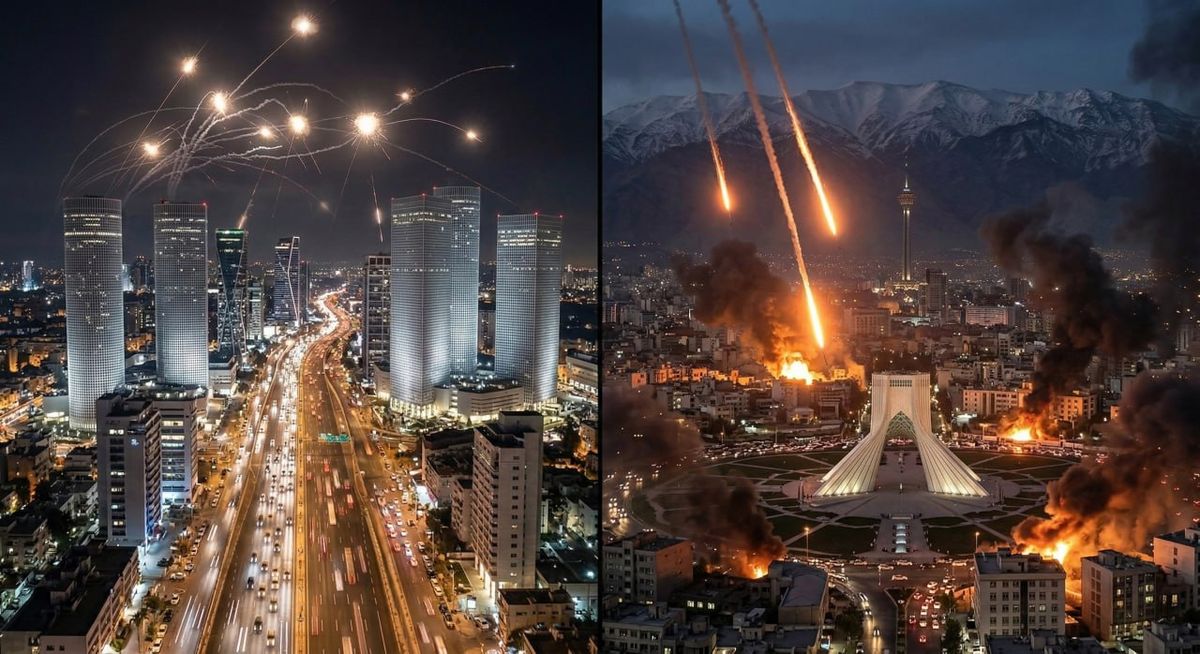
It is 1:05 on a Saturday morning and I have just come up from the shelter again. The seventh night. My children are asleep on mattresses we dragged down a week ago and have not bothered to drag back up because there is no point. The sirens come and the sirens stop and the sirens come again, and in the intervals you learn that the world has not ended, only rearranged itself into something you do not yet have the language to describe. A week ago I was in a hotel room in London. Warm and still. The Thames invisible in the dark below. Oman’s foreign minister had announced a breakthrough. Iran, he said, had agreed to full IAEA verification, to never stockpile enriched uranium, to irreversibly downgrade what it had spent four decades assembling. A deal, he said, was within reach.
There is no sound in the human catalog that does to the body what an Israeli air raid siren does. It is not a sound. It is a rearrangement of priorities.
I read this and felt something I recognized seven days later as the particular calm that precedes catastrophe: the relief of a man who believes the bill will not come due tonight. It came due the next morning. It has been coming due every night since.
I booked my flight. I landed in Israel on Friday. I went to sleep.
Saturday morning, the first siren. I have lost count of how many have followed. My children have not.
There is no sound in the human catalog that does to the body what an Israeli air raid siren does. It is not a sound. It is a rearrangement of priorities. Every biological instruction your nervous system has ever received is instantly overwritten. You do not think. You move. You move toward your children.
By the time we were in the shelter, the first booms had begun, deep and directional, the sound of Iron Dome intercepting what the regime in Tehran had aimed at my neighborhood, my children, the particular coordinates of my life. Each boom was, in fact, a small victory. A missile that did not land. I know this intellectually. In the dark of a shelter with four children, intellect is the last thing you have.
What I knew in that shelter by 10:30 on the first Saturday morning was this: the United States and Israel had begun striking Iran. President Donald Trump had posted an eight-minute video announcement on Truth Social at 9:30 AM. Two hundred Israeli jets had hit nearly five hundred targets. CENTCOM had described it as the largest regional concentration of American military firepower in a generation. Iran had already begun retaliating, which was why the sirens were sounding over Tel Aviv. What I know now, seven days and more than two thousand strikes later, is that the sirens have not stopped. They have become the rhythm of a new life none of us chose.
For the first hours, Ali Khamenei’s whereabouts were unknown. Iranian state media said he was alive. His foreign minister told NBC News he was alive, as far as he knew. Israeli intelligence said something different. By Sunday morning, Iranian state media confirmed what the intelligence had already told us. He was dead. His wife, Mansoureh Khojasteh Bagherzadeh, died of her injuries two days later. His daughter, son-in-law, and grandchild were also killed. The state declared forty days of mourning.
The week that followed is difficult to describe as a single experience because it was not one. It was seven days of competing realities running simultaneously, each day longer and stranger than the last: children who needed lunch and also needed to understand why lunch was eaten in the shelter; phone calls from Washington, from London, from Jerusalem, from journalists in six time zones who needed a sentence or a strategic framework for what they were watching; intelligence updates arriving faster than they could be processed; the accumulation of exhaustion that turns a human being into something that functions on caffeine and obligation; and underneath all of it, the question that no one on any secure channel would answer definitively.
It was seven days of competing realities running simultaneously, each day longer and stranger than the last: children who needed lunch and also needed to understand why lunch was eaten in the shelter.
It was that first Saturday evening when the unnamed Israeli official told the press what the intelligence channels had been saying all day. That Khamenei had been found in the rubble of his compound. That his body had been identified. That Ali Khamenei, Supreme Leader of the Islamic Republic of Iran, eighty-six years old, was dead. That was seven days ago. It already feels like a century.
The man who had organized more terrorist violence than any head of state since the end of the Second World War, who had funded Hamas, Hezbollah, the Houthis, and the Popular Mobilization Forces. The man who had watched thousands of his own citizens shot in the streets of Tehran, Mashhad, and Isfahan during the largest protests Iran had seen since 1979, and had answered their rage with bullets. The man who had pointed forty-seven years of revolutionary fury at the idea of a Jewish state, at the idea of America, at the very principle that free people have a right to remain free.
Dead.
Iranian state media would not confirm it until the following morning. But I sat with that word that evening in a room that still smelled of the shelter, and I did not feel what I had expected to feel. I felt something closer to grief.
II. The Observers and the Observed
George Orwell wrote “Looking Back on the Spanish War” from London in 1942, three years after Franco had won and four years after Orwell had taken a fascist bullet through the throat. He was trying to understand what it meant to have fought on the losing side of a necessary war, and he concluded that the most important thing a person can do in a moment of historical crisis is to insist on the facts when everyone around him is lying. That is what he called it: insisting on the facts. He did not say “speaking truth to power.” He said insisting. The verb matters.
Joan Didion wrote The Year of Magical Thinking from a chair in her apartment, trying to understand how grief works, how the mind refuses to accept what the body knows. She identified the mechanism: magical thinking, the delusion that if you hold the right thoughts in the right order, the catastrophe will reverse itself. She documented this not to cure it but to name it, because naming a delusion is the only thing that distinguishes it from belief.
Statue of George Orwell by the British sculptor Martin Jennings outside Broadcasting House, the headquarters of the BBC in central London.
Statue of George Orwell by the British sculptor Martin Jennings outside Broadcasting House, the headquarters of the BBC in central London.Shutterstock
Michael Herr went to Vietnam and came back with his nervous system rewired. In Dispatches he described what war does to the sensorium: the way it makes ordinary life feel thin and fraudulent, the way it gets inside you and becomes something you need. He was honest about that need in a way that made many people uncomfortable, and the discomfort was the point.
I have read all three of these books more than once, and I have thought about them constantly in the days since February 28. The thing that separates my situation from each of theirs is not bravery or intelligence or the proximity of danger. It is this: None of them was simultaneously inside the event, outside the event, and responsible for explaining the event to the world while it was happening.
Orwell was a combatant who became a witness. Didion was a witness to private grief who became a chronicler. Herr was a journalist who became a participant in ways he had not anticipated. I am something the twentieth century did not have a template for: an analyst, an advocate, an operator, a husband, a father, and a man in a bomb shelter trying to write a press release in the dark.
For twenty hours each day since the strikes began, I have sat at a computer and done what I have spent fifteen years training to do. I have called journalists. I have briefed diplomats. I have written statements, op-eds, intelligence summaries, donor updates, social media threads, and background papers. I have made the case, in every medium available, that what the United States and Israel are doing is not aggression. It is the belated arrival of justice.
But I am writing this now because none of those documents contains what I actually know about this war. They contain what I know as a professional. This is what I know as a human being.
III. What Is Lost
A woman in her forties was killed in Tel Aviv when an Iranian missile struck her building on the first night of the war. She was a home health aide. She had been caring for someone who could not care for themselves, which is one of the most human things a person can do, and she was killed by a regime that had spent forty-seven years organizing its foreign policy around the destruction of the country she lived in. In Beit Shemesh, nine people died in a single strike—among them three teenage siblings, Yaakov, Avigail, and Sarah Bitton, killed in a bomb shelter whose roof collapsed under a 500-kilogram Iranian warhead. The shelter had been built to save them. It did not. Magen David Adom treated eighty-nine people in the first hours of Iran’s retaliation, three from direct hits, the rest from the secondary costs of running, falling, panicking—the body’s response to the fact that someone is trying to kill it.
At the Red Crescent count seventeen hours into the first day of strikes: 201 dead in Iran, 747 injured. One week later, as I write this, the count has risen past 1,300 dead and more than 6,000 wounded. In Israel, twelve civilians have been killed and more than 1,600 injured. Six American soldiers are dead, all killed in a single Iranian airstrike on a base in Kuwait. Nine more are dead across the Gulf states. In Lebanon, where Israel has struck Hezbollah in response to rocket fire, 123 people have been killed. These are the numbers that do not appear on the official target lists. They appear in the accounting that every nation owes its enemies’ civilians, the accounting that distinguishes a military operation from a massacre.
Iranian soldiers died in those strikes. Conscripts, many of them. Young men who did not design the Islamic Revolutionary Guard Corps or its ideology, who were handed a uniform and told that their enemies were America and Israel and the West, who may have privately doubted this and publicly complied, because publicly doubting it in the Islamic Republic carries a price most people are not willing to pay. Some of them had names I will never know, families who will mourn them, mothers who will not understand why their sons died in the service of a cause that was never theirs to choose.
Because you cannot say that war is against a regime and not a people if you are not willing to grieve the people.
I mourn them. I mourn all of them, and I need to say this plainly because it will be misunderstood, because in the current political climate everything is misunderstood: mourning the dead on the other side is not weakness and it is not moral equivalence. It is the precondition for everything I believe about why this war was necessary.
Because you cannot say that war is against a regime and not a people if you are not willing to grieve the people.
The Iranian people have been dying at the hands of this regime for forty-seven years. Between three thousand and thirty-two thousand of them were killed by their own government during the protests of late 2025, the largest uprising since the revolution. These were not dissidents or intellectuals. These were people who could no longer afford bread. People whose daughters had been arrested for showing their hair. People who had watched their country’s treasury spent on Hezbollah and Hamas while their own children went hungry. They took to the streets because they had run out of alternatives, and the regime shot them.
The Starlink terminals we deployed inside Iran before the strikes, 470 of them, were not a geopolitical maneuver. They were an act of faith in the Iranian people. The Iran Freedom Congress in London was not a conference. It was an argument: that the people inside that country deserve the same things every free person takes for granted. Information. Connection. The ability to communicate their suffering to the world without the regime’s permission.
You cannot deploy Starlink terminals inside a country and then watch that country’s conscripts die in a war you helped bring about and feel nothing. You should not feel nothing. The moral weight of this moment is enormous, and anyone who tells you otherwise is selling something.
IV. A War Against a Regime
There is a distinction that will define everything that comes after this conflict, and it is not being made clearly enough in the coverage I have read: this war is against the Islamic Republic of Iran. It is not against Iran. It is not against the Persian civilization that produced Hafez and Rumi and Mossadegh. It is not against the 40 million Iranians who are younger than the revolution that imprisoned them. It is not against the Kurdish woman who removed her hijab in 2022 and started a movement that the regime has been trying to extinguish ever since.
The distinction is not rhetorical. It is strategic. It is moral. It is the only framework under which a victory in this conflict means anything other than the substitution of one form of despotism for another.
Trump said in his announcement that the hour of freedom was at hand for the Iranian people. Netanyahu said the top security leadership of the Iranian terror regime had been eliminated. These are not identical statements, and the gap between them is where the postwar question lives. Leadership elimination is a military objective. Freedom is a civilizational one. The United States military can accomplish the first. Nobody, not the U.S., not Israel, not the West, can accomplish the second on behalf of the Iranian people. They have to do that themselves.
Jewish tradition holds that the obligation of rescue, pikuach nefesh, the saving of a life, overrides nearly every other commandment. You break the Sabbath to save a life.
What we owe them is the removal of the obstacle. The removal of the regime that has been shooting them in the streets. The removal of the IRGC commanders who have been the instrument of that shooting. And then, critically, we owe them the space to build what comes next without a new set of foreign hands shaping it according to foreign interests.
Jewish tradition holds that the obligation of rescue, pikuach nefesh, the saving of a life, overrides nearly every other commandment. You break the Sabbath to save a life. You violate almost any rule to preserve the life of another human being. The tradition does not say you save only Jewish lives, or only the lives of people who agree with you. It says you save the life in front of you. American and Israeli intervention was an expression of this. So was the decision to strike the regime before it acquired the nuclear weapon it had been building toward for thirty years. You do not wait for the gun to be at your temple before you act. That is not caution. It is something closer to collaboration with your own destruction.
The American founding tradition says the same thing in different language. Jefferson wrote that when a government becomes destructive of life, liberty, and the pursuit of happiness, it is the right of the people to alter or abolish it. He wrote that for Americans. It also describes every Iranian who has been protesting in the streets since 2022. The right to alter or abolish a destructive government is not an American right. It is a human right that Americans happened to codify first.
V. The Booms Above the Shelter
There is a sound that Iron Dome, David’s Sling, and the Arrow make when they kill an incoming missile. It is a concussive crack, higher and sharper than a bomb, the sound of a system designed by Israeli engineers and built by Israeli workers doing exactly what it was designed to do. Each crack means a warhead that did not reach its target. Each crack means somebody is alive who might not have been.
My children do not know the technical explanation. They know the sound. They have learned, as Israeli children learn, to treat the crack as reassurance rather than terror. This is not innocence. It is a specific kind of knowledge that civilian populations in this part of the world develop over generations: the knowledge of which sounds mean you are being protected and which sounds mean the protection has failed.
I sat in that shelter and thought about the Iraqi children who learned the same taxonomy of sounds in 2003. The Afghan children who learned it for decades. The children in Tehran in the first hours of February 28, 2026, who heard the other side of the sounds I was hearing, the sounds of incoming rather than intercepted, the sounds of the American and Israeli targeting systems finding their marks in the city above them.
War distributes its sounds without mercy and without discrimination. The crater does not ask the politics of the child standing next to it. This is not an argument against war. It is an argument for conducting it with absolute precision, absolute accountability, and an absolute commitment to the moment it ends.
Because wars have to end. And how they end is the only thing that determines whether they were worth their cost.
VI. The Screen at Three in the Morning
I have been asked, every day for a week now, whether it is strange to be in Israel during a war that I have spent years advocating for. Whether I feel implicated. Whether there is cognitive dissonance between the strategic arguments I have made in Washington conference rooms and the sirens I have heard over Tel Aviv, forty-three of them and counting.
The answer is no. Not because I am certain I was right. Certainty of that kind is not available to honest people. The answer is no because the alternative to advocacy is silence, and silence about a regime that was building nuclear weapons while shooting its citizens in the streets is not neutrality. It is a choice. It is a choice to let the situation develop until someone else makes a decision about it, usually someone with worse values and worse information than you have.
The choice was not between intervention and stability. The choice was between intervention now and intervention later, under worse conditions, after a nuclear test.
I think about Tucker Carlson’s argument, which is the best version of the isolationist case: America has made catastrophic mistakes in the Middle East before, and there is no reason to believe this intervention will be different. This is not a stupid argument. It deserves a serious response rather than a dismissal. The serious response is this: the Islamic Republic of Iran was not a contained problem. It was an expanding one. It had reached operational nuclear threshold. It had proxy armies in seven countries. It had killed Americans, Israelis, Saudis, Yemenis, Iraqis, Syrians, and Iranians in the service of a revolutionary ideology that its own people had rejected and that the international order had proved incapable of constraining. The choice was not between intervention and stability. The choice was between intervention now and intervention later, under worse conditions, after a nuclear test.
I do not write this to re-litigate the decision. The decision is made. The war is a week old and the war is not over and the postwar debate has already begun, in every newsroom and every legislature and every living room where someone is watching the footage and trying to decide what they think. That debate will be won or lost on the clarity of the argument for why it was necessary. I am writing this at 1:05 in the morning because clarity is the only thing I can offer that the missiles cannot.
Every night at three in the morning in Tel Aviv, with the last of the day’s briefings sent and the children finally asleep after the sirens have stopped, I sit with my phone and read the reports from Tehran. Every night it is worse. Hospitals hit. A school in Minab where more than 160 girls were killed. The Tehran Grand Bazaar damaged. The Golestan Palace, a relic of a civilization that predates the revolution by centuries, struck. The Red Crescent counting its dead, the count rising from 201 to 555 to 1,045 to more than 1,300. And every night I think about Orwell’s formulation: insisting on the facts. All of them. Not only the facts that support the argument you have already made.
The facts are this: the Islamic Republic of Iran was a regime that had to be stopped. The facts are also this: stopping it has cost lives that did not deserve to be costs. Both of these things are true. The inability to hold both simultaneously is the thing that makes advocates dangerous and the thing that makes isolationists irresponsible.
VII. The Questions That Remain
One week in, this is what is confirmed. Khamenei is dead. His wife is dead. His daughter, son-in-law, and grandchild are dead. Defense Minister Aziz Nasirzadeh and IRGC commander Mohammad Pakpour are likely dead. Some forty senior officials were killed in the opening hours. The IRGC Malek-Ashtar building in Tehran has been reduced to rubble. The state broadcaster’s headquarters has been hit. The parliament building has been targeted. Israel bombed the Assembly of Experts while they were meeting to elect the next supreme leader. More than thirty Iranian naval vessels have been destroyed, including the drone carrier Shahid Bagheri. Eighty percent of Iran’s air defenses are gone. Sixty percent of its missile launch capability is gone. B-2 bombers are now dismantling what remains of its defense industries. US and Israeli jets fly uncontested over Iranian territory. Kurdish-Iranian armed groups have launched a ground offensive in the northwest. Iran has retaliated across nine countries. Russia is feeding Tehran intelligence on the locations of American warships. And somewhere inside a country whose internet dropped by forty-six percent in the first hours, the people who have been waiting for this moment are trying to find each other in the dark. One hundred thousand of them fled Tehran in the first two days alone.
What comes after is the only question that matters now, and I do not have an answer, and anyone who tells you they do is lying.
Will the IRGC commander who replaces Khamenei be worse? Possibly. The CIA’s assessment is that a hardliner from the Revolutionary Guard is the most likely successor, a man whose formation is entirely inside the revolutionary system, who has no memory of Iran before 1979, who has no framework for legitimacy other than the one the revolution gave him. If this man consolidates power, the strikes will have removed an 86-year-old ideologue and replaced him with a 50-year-old one who has nothing to lose.
This is the scenario that should keep every architect of this operation awake at night.
A region without a nuclear-capable Iran is a different strategic environment than anyone in the Israeli security establishment has experienced in their professional lives.
Or, the regime fractures. The protests that killed thousands in late 2025 resume, now with the knowledge that the IRGC cannot protect itself from the sky, let alone protect the regime from its own people. The Iranian people, who have been waiting for this moment through forty-seven years of theocratic rule, do what no foreign military can do for them: they choose their own future.
This is the scenario that everyone who supported this operation is betting on.
I believe it is the more likely one. I believe this not out of optimism, which is a form of intellectual laziness, but out of the evidence of what the Iranian people have been saying for years, with their feet in the streets, with their faces uncovered in public, with the daughters of clerics removing their hijabs in university courtyards and daring anyone to stop them. The Iranian people are not a passive object of this conflict. They are its latent protagonist.
But the bet is real, and it is large, and the people whose lives are the stakes are not the ones who placed it.
Israel now faces the question of what it is for, not just what it is against. For seventy-eight years, the state’s existence has been organized largely around the management of existential threats. The threats have not disappeared: Hezbollah remains, Iran’s regional proxies remain, the question of Gaza remains. But the nature of the threat has changed. A region without a nuclear-capable Iran is a different strategic environment than anyone in the Israeli security establishment has experienced in their professional lives. What do you do with a strategic horizon that is not entirely consumed by the management of catastrophe?
America faces the question of what it owes the Iranian people now. The President said their freedom was at hand. Freedom is not delivered by airstrike. It is built by institutions, by civil society, by the slow and unglamorous work of people who have decided that they will live differently than they have been told to live. The United States, historically, has been more reliable at destroying governments than at helping populations build what comes after. This history is not destiny. But it is a warning.
The West faces the question of whether the values it invokes in moments of crisis are the values it will sustain in the years of reconstruction. Whether the countries that expressed solidarity with Israel on October 7, 2023, and then spent two years hedging, qualify, and conditioning that solidarity will now make the long-term commitments that postwar Iran will require. Whether Europe, which has spent thirty years managing its relationship with Iran through the machinery of diplomatic process, has the institutional capacity to engage with an Iran that is no longer organized around the Islamic Republic.
These are not rhetorical questions. One week in, with the fires still burning and the sirens still sounding, they are the questions that will determine whether February 28, 2026, is remembered as the beginning of something or as the beginning of something else. We do not have the luxury of answering them later. Later is a privilege that belongs to people whose children are not sleeping on mattresses in sealed rooms.
VIII. What I Know in the Shelter
The Talmud says that whoever saves a single soul, it is as if he saved an entire world. The inverse is also true: whoever destroys a single soul destroys a world. The Islamic Republic of Iran destroyed thousands of worlds. The military operation that is destroying the Islamic Republic has destroyed others. More than 1,300 in Iran at last count. Twelve in Israel. Six American soldiers. Children in a school in Minab. Children in a shelter in Beit Shemesh. The math of this does not resolve into a simple equation. It lives in the territory of tragedy, which is not the same as error.
The Talmud says that whoever saves a single soul, it is as if he saved an entire world. The inverse is also true: whoever destroys a single soul destroys a world.
I have four children. They have been in the shelter with me for seven days. They no longer ask if the booms are thunder. They know what the booms are. My youngest has stopped flinching. I do not know if this is resilience or something I should be more worried about. My oldest has started keeping a tally of the sirens on the back of a notebook. She is up to forty-three. They look at me with the particular expression that children reserve for moments when they need to know whether the adult in the room has things under control.
I have told them we are safe every night for a week. This has been true in the immediate sense every time I have said it. In the larger sense, the question of whether we are safe is the one that every generation in every country that has ever sat at the hinge of history has had to answer for itself, through its choices, its courage, and the honesty of its accounting.
I am not a soldier. I have not been one for a long time. I did not drop the ordnance. I did not intercept the missiles. For seven days I have sat at a computer and made arguments, written briefings, fielded calls, and tried to explain to the world what is happening above my head while my children sleep ten feet away on a concrete floor. This is what I know how to do. This is the thing I have spent fifteen years building the capacity to do at exactly this kind of moment. Whether those arguments contributed to the decision that was made is something I will spend the rest of my life trying to assess honestly. Whether I have been equal to this week is something I will never be sure of.
Orwell wanted to insist on the facts. Didion wanted to understand grief without magical thinking. Herr wanted to be honest about what war does to the person who watches it closely.
I want something different from all three of them, and more demanding: I want the argument that this war was necessary to be true. Not defensible. Not strategic. True. I have wanted this for seven days and seven nights and I have not stopped wanting it for a single hour, not when the sirens came, not when the casualty counts climbed, not when I read about the school in Minab and had to set my phone down and sit with the weight of it. And I want the postwar work to be worthy of the people who died in the shelter, on the missile site, in the street, on both sides, in the name of a future that none of us can yet fully describe. I want it with a fury that has not diminished in a week. It has grown.
The booms above Tel Aviv have not stopped. They have become the metronome of a week I will carry for the rest of my life. Each one is the sound of a forty-seven-year catastrophe reaching its last chapter, and each one is also the sound of a new chapter being written in the dark, by people who do not yet know what it will say. In Tehran, where the rooftops filled with people on the first night who were not mourning but watching, and who were not afraid. In Beit Shemesh, where they are still pulling rubble off the shelter that was supposed to save three children and did not. In a school in Minab where more than 160 girls will never come home. Whether the next chapter is written well is not yet determined. That determination is the work of the living. It is the only work that justifies the cost of what the dead have paid.
I do not know if we will do it well. I know we are obligated to try. I know my children are asleep downstairs in a room with concrete walls. I know it is 1:05 in the morning and the last siren was forty minutes ago and the next one could come before I finish this sentence. I know that somewhere in Tehran a mother is sitting in the dark with her children and she does not have a shelter and she does not have Iron Dome and she did not choose this any more than my children did. I know that what we owe her, and what we owe the dead, and what we owe the living, is to be worthy of this terrible hour. I do not know if we will be. I know that the trying is not optional.
I climb the stairs from the shelter one more time. The air outside is cool and smells like jasmine and something faintly chemical that might be my imagination.
One week is not enough time to know what this war has accomplished. It is barely enough time to count the dead, and we have not finished counting. It is enough time to know what it has cost: more than a thousand Iranian lives, at least twelve Israeli ones, six American ones, and a number of certainties that will not be replaced. The certainty that the Islamic Republic was permanent. The certainty that nuclear weapons could be developed in secret and kept in secret. The certainty that the Middle East had a fixed architecture that could not be moved. All of these were true seven days ago. None of them are true now.
My daughter will not remember this week. She is too young. My son might remember the sound, or the shelter, or the way his father looked at three in the morning when the phone buzzed with another alert. He will not remember what I was thinking, which is what every parent thinks during a war: not yet. Not them. Whatever else happens, not them. It is the most ancient prayer in the world, and it has no denominational requirements.
I climb the stairs from the shelter one more time. The air outside is cool and smells like jasmine and something faintly chemical that might be my imagination. The street is empty. A car alarm is going off three blocks away, the way car alarms always go off after the booms, as if the cars are mourning too. I stand in the doorway of my home in a country that has just helped end a regime that wanted to end it, and I do not feel triumphant, and I do not feel safe, and I do not feel the war is over. I feel the specific gravity of being alive at the end of the first week of something whose last week has not yet been written.
(Gregg Roman is the executive director of the Middle East Forum, previously directing the Community Relations Council of the Jewish Federation of Greater Pittsburgh. In 2014, the Jewish Telegraphic Agency named him one of the “ten most inspiring global Jewish leaders,” and he previously served as the political advisor to the deputy foreign minister of Israel and worked for the Israeli Ministry of Defense. A frequent speaker on Middle East affairs, Mr. Roman appears on international news channels such as Fox News, i24NEWS, Al-Jazeera, BBC World News, and Israel’s Channels 12 and 13. He studied national security and political communications at American University and the Interdisciplinary Center in Herzliya, and has contributed to The Hill, Newsweek, the Los Angeles Times, the Miami Herald, and the Jerusalem Post.)
There is no sound in the human catalog that does to the body what an Israeli air raid siren does. It is not a sound. It is a rearrangement of priorities.
I read this and felt something I recognized seven days later as the particular calm that precedes catastrophe: the relief of a man who believes the bill will not come due tonight. It came due the next morning. It has been coming due every night since.
I booked my flight. I landed in Israel on Friday. I went to sleep.
Saturday morning, the first siren. I have lost count of how many have followed. My children have not.
There is no sound in the human catalog that does to the body what an Israeli air raid siren does. It is not a sound. It is a rearrangement of priorities. Every biological instruction your nervous system has ever received is instantly overwritten. You do not think. You move. You move toward your children.
By the time we were in the shelter, the first booms had begun, deep and directional, the sound of Iron Dome intercepting what the regime in Tehran had aimed at my neighborhood, my children, the particular coordinates of my life. Each boom was, in fact, a small victory. A missile that did not land. I know this intellectually. In the dark of a shelter with four children, intellect is the last thing you have.
What I knew in that shelter by 10:30 on the first Saturday morning was this: the United States and Israel had begun striking Iran. President Donald Trump had posted an eight-minute video announcement on Truth Social at 9:30 AM. Two hundred Israeli jets had hit nearly five hundred targets. CENTCOM had described it as the largest regional concentration of American military firepower in a generation. Iran had already begun retaliating, which was why the sirens were sounding over Tel Aviv. What I know now, seven days and more than two thousand strikes later, is that the sirens have not stopped. They have become the rhythm of a new life none of us chose.
For the first hours, Ali Khamenei’s whereabouts were unknown. Iranian state media said he was alive. His foreign minister told NBC News he was alive, as far as he knew. Israeli intelligence said something different. By Sunday morning, Iranian state media confirmed what the intelligence had already told us. He was dead. His wife, Mansoureh Khojasteh Bagherzadeh, died of her injuries two days later. His daughter, son-in-law, and grandchild were also killed. The state declared forty days of mourning.
The week that followed is difficult to describe as a single experience because it was not one. It was seven days of competing realities running simultaneously, each day longer and stranger than the last: children who needed lunch and also needed to understand why lunch was eaten in the shelter; phone calls from Washington, from London, from Jerusalem, from journalists in six time zones who needed a sentence or a strategic framework for what they were watching; intelligence updates arriving faster than they could be processed; the accumulation of exhaustion that turns a human being into something that functions on caffeine and obligation; and underneath all of it, the question that no one on any secure channel would answer definitively.
It was seven days of competing realities running simultaneously, each day longer and stranger than the last: children who needed lunch and also needed to understand why lunch was eaten in the shelter.
It was that first Saturday evening when the unnamed Israeli official told the press what the intelligence channels had been saying all day. That Khamenei had been found in the rubble of his compound. That his body had been identified. That Ali Khamenei, Supreme Leader of the Islamic Republic of Iran, eighty-six years old, was dead. That was seven days ago. It already feels like a century.
The man who had organized more terrorist violence than any head of state since the end of the Second World War, who had funded Hamas, Hezbollah, the Houthis, and the Popular Mobilization Forces. The man who had watched thousands of his own citizens shot in the streets of Tehran, Mashhad, and Isfahan during the largest protests Iran had seen since 1979, and had answered their rage with bullets. The man who had pointed forty-seven years of revolutionary fury at the idea of a Jewish state, at the idea of America, at the very principle that free people have a right to remain free.
Dead.
Iranian state media would not confirm it until the following morning. But I sat with that word that evening in a room that still smelled of the shelter, and I did not feel what I had expected to feel. I felt something closer to grief.
II. The Observers and the Observed
George Orwell wrote “Looking Back on the Spanish War” from London in 1942, three years after Franco had won and four years after Orwell had taken a fascist bullet through the throat. He was trying to understand what it meant to have fought on the losing side of a necessary war, and he concluded that the most important thing a person can do in a moment of historical crisis is to insist on the facts when everyone around him is lying. That is what he called it: insisting on the facts. He did not say “speaking truth to power.” He said insisting. The verb matters.
Joan Didion wrote The Year of Magical Thinking from a chair in her apartment, trying to understand how grief works, how the mind refuses to accept what the body knows. She identified the mechanism: magical thinking, the delusion that if you hold the right thoughts in the right order, the catastrophe will reverse itself. She documented this not to cure it but to name it, because naming a delusion is the only thing that distinguishes it from belief.
Statue of George Orwell by the British sculptor Martin Jennings outside Broadcasting House, the headquarters of the BBC in central London.
Statue of George Orwell by the British sculptor Martin Jennings outside Broadcasting House, the headquarters of the BBC in central London.Shutterstock
Michael Herr went to Vietnam and came back with his nervous system rewired. In Dispatches he described what war does to the sensorium: the way it makes ordinary life feel thin and fraudulent, the way it gets inside you and becomes something you need. He was honest about that need in a way that made many people uncomfortable, and the discomfort was the point.
I have read all three of these books more than once, and I have thought about them constantly in the days since February 28. The thing that separates my situation from each of theirs is not bravery or intelligence or the proximity of danger. It is this: None of them was simultaneously inside the event, outside the event, and responsible for explaining the event to the world while it was happening.
Orwell was a combatant who became a witness. Didion was a witness to private grief who became a chronicler. Herr was a journalist who became a participant in ways he had not anticipated. I am something the twentieth century did not have a template for: an analyst, an advocate, an operator, a husband, a father, and a man in a bomb shelter trying to write a press release in the dark.
For twenty hours each day since the strikes began, I have sat at a computer and done what I have spent fifteen years training to do. I have called journalists. I have briefed diplomats. I have written statements, op-eds, intelligence summaries, donor updates, social media threads, and background papers. I have made the case, in every medium available, that what the United States and Israel are doing is not aggression. It is the belated arrival of justice.
But I am writing this now because none of those documents contains what I actually know about this war. They contain what I know as a professional. This is what I know as a human being.
III. What Is Lost
A woman in her forties was killed in Tel Aviv when an Iranian missile struck her building on the first night of the war. She was a home health aide. She had been caring for someone who could not care for themselves, which is one of the most human things a person can do, and she was killed by a regime that had spent forty-seven years organizing its foreign policy around the destruction of the country she lived in. In Beit Shemesh, nine people died in a single strike—among them three teenage siblings, Yaakov, Avigail, and Sarah Bitton, killed in a bomb shelter whose roof collapsed under a 500-kilogram Iranian warhead. The shelter had been built to save them. It did not. Magen David Adom treated eighty-nine people in the first hours of Iran’s retaliation, three from direct hits, the rest from the secondary costs of running, falling, panicking—the body’s response to the fact that someone is trying to kill it.
At the Red Crescent count seventeen hours into the first day of strikes: 201 dead in Iran, 747 injured. One week later, as I write this, the count has risen past 1,300 dead and more than 6,000 wounded. In Israel, twelve civilians have been killed and more than 1,600 injured. Six American soldiers are dead, all killed in a single Iranian airstrike on a base in Kuwait. Nine more are dead across the Gulf states. In Lebanon, where Israel has struck Hezbollah in response to rocket fire, 123 people have been killed. These are the numbers that do not appear on the official target lists. They appear in the accounting that every nation owes its enemies’ civilians, the accounting that distinguishes a military operation from a massacre.
Iranian soldiers died in those strikes. Conscripts, many of them. Young men who did not design the Islamic Revolutionary Guard Corps or its ideology, who were handed a uniform and told that their enemies were America and Israel and the West, who may have privately doubted this and publicly complied, because publicly doubting it in the Islamic Republic carries a price most people are not willing to pay. Some of them had names I will never know, families who will mourn them, mothers who will not understand why their sons died in the service of a cause that was never theirs to choose.
Because you cannot say that war is against a regime and not a people if you are not willing to grieve the people.
I mourn them. I mourn all of them, and I need to say this plainly because it will be misunderstood, because in the current political climate everything is misunderstood: mourning the dead on the other side is not weakness and it is not moral equivalence. It is the precondition for everything I believe about why this war was necessary.
Because you cannot say that war is against a regime and not a people if you are not willing to grieve the people.
The Iranian people have been dying at the hands of this regime for forty-seven years. Between three thousand and thirty-two thousand of them were killed by their own government during the protests of late 2025, the largest uprising since the revolution. These were not dissidents or intellectuals. These were people who could no longer afford bread. People whose daughters had been arrested for showing their hair. People who had watched their country’s treasury spent on Hezbollah and Hamas while their own children went hungry. They took to the streets because they had run out of alternatives, and the regime shot them.
The Starlink terminals we deployed inside Iran before the strikes, 470 of them, were not a geopolitical maneuver. They were an act of faith in the Iranian people. The Iran Freedom Congress in London was not a conference. It was an argument: that the people inside that country deserve the same things every free person takes for granted. Information. Connection. The ability to communicate their suffering to the world without the regime’s permission.
You cannot deploy Starlink terminals inside a country and then watch that country’s conscripts die in a war you helped bring about and feel nothing. You should not feel nothing. The moral weight of this moment is enormous, and anyone who tells you otherwise is selling something.
IV. A War Against a Regime
There is a distinction that will define everything that comes after this conflict, and it is not being made clearly enough in the coverage I have read: this war is against the Islamic Republic of Iran. It is not against Iran. It is not against the Persian civilization that produced Hafez and Rumi and Mossadegh. It is not against the 40 million Iranians who are younger than the revolution that imprisoned them. It is not against the Kurdish woman who removed her hijab in 2022 and started a movement that the regime has been trying to extinguish ever since.
The distinction is not rhetorical. It is strategic. It is moral. It is the only framework under which a victory in this conflict means anything other than the substitution of one form of despotism for another.
Trump said in his announcement that the hour of freedom was at hand for the Iranian people. Netanyahu said the top security leadership of the Iranian terror regime had been eliminated. These are not identical statements, and the gap between them is where the postwar question lives. Leadership elimination is a military objective. Freedom is a civilizational one. The United States military can accomplish the first. Nobody, not the U.S., not Israel, not the West, can accomplish the second on behalf of the Iranian people. They have to do that themselves.
Jewish tradition holds that the obligation of rescue, pikuach nefesh, the saving of a life, overrides nearly every other commandment. You break the Sabbath to save a life.
What we owe them is the removal of the obstacle. The removal of the regime that has been shooting them in the streets. The removal of the IRGC commanders who have been the instrument of that shooting. And then, critically, we owe them the space to build what comes next without a new set of foreign hands shaping it according to foreign interests.
Jewish tradition holds that the obligation of rescue, pikuach nefesh, the saving of a life, overrides nearly every other commandment. You break the Sabbath to save a life. You violate almost any rule to preserve the life of another human being. The tradition does not say you save only Jewish lives, or only the lives of people who agree with you. It says you save the life in front of you. American and Israeli intervention was an expression of this. So was the decision to strike the regime before it acquired the nuclear weapon it had been building toward for thirty years. You do not wait for the gun to be at your temple before you act. That is not caution. It is something closer to collaboration with your own destruction.
The American founding tradition says the same thing in different language. Jefferson wrote that when a government becomes destructive of life, liberty, and the pursuit of happiness, it is the right of the people to alter or abolish it. He wrote that for Americans. It also describes every Iranian who has been protesting in the streets since 2022. The right to alter or abolish a destructive government is not an American right. It is a human right that Americans happened to codify first.
V. The Booms Above the Shelter
There is a sound that Iron Dome, David’s Sling, and the Arrow make when they kill an incoming missile. It is a concussive crack, higher and sharper than a bomb, the sound of a system designed by Israeli engineers and built by Israeli workers doing exactly what it was designed to do. Each crack means a warhead that did not reach its target. Each crack means somebody is alive who might not have been.
My children do not know the technical explanation. They know the sound. They have learned, as Israeli children learn, to treat the crack as reassurance rather than terror. This is not innocence. It is a specific kind of knowledge that civilian populations in this part of the world develop over generations: the knowledge of which sounds mean you are being protected and which sounds mean the protection has failed.
I sat in that shelter and thought about the Iraqi children who learned the same taxonomy of sounds in 2003. The Afghan children who learned it for decades. The children in Tehran in the first hours of February 28, 2026, who heard the other side of the sounds I was hearing, the sounds of incoming rather than intercepted, the sounds of the American and Israeli targeting systems finding their marks in the city above them.
War distributes its sounds without mercy and without discrimination. The crater does not ask the politics of the child standing next to it. This is not an argument against war. It is an argument for conducting it with absolute precision, absolute accountability, and an absolute commitment to the moment it ends.
Because wars have to end. And how they end is the only thing that determines whether they were worth their cost.
VI. The Screen at Three in the Morning
I have been asked, every day for a week now, whether it is strange to be in Israel during a war that I have spent years advocating for. Whether I feel implicated. Whether there is cognitive dissonance between the strategic arguments I have made in Washington conference rooms and the sirens I have heard over Tel Aviv, forty-three of them and counting.
The answer is no. Not because I am certain I was right. Certainty of that kind is not available to honest people. The answer is no because the alternative to advocacy is silence, and silence about a regime that was building nuclear weapons while shooting its citizens in the streets is not neutrality. It is a choice. It is a choice to let the situation develop until someone else makes a decision about it, usually someone with worse values and worse information than you have.
The choice was not between intervention and stability. The choice was between intervention now and intervention later, under worse conditions, after a nuclear test.
I think about Tucker Carlson’s argument, which is the best version of the isolationist case: America has made catastrophic mistakes in the Middle East before, and there is no reason to believe this intervention will be different. This is not a stupid argument. It deserves a serious response rather than a dismissal. The serious response is this: the Islamic Republic of Iran was not a contained problem. It was an expanding one. It had reached operational nuclear threshold. It had proxy armies in seven countries. It had killed Americans, Israelis, Saudis, Yemenis, Iraqis, Syrians, and Iranians in the service of a revolutionary ideology that its own people had rejected and that the international order had proved incapable of constraining. The choice was not between intervention and stability. The choice was between intervention now and intervention later, under worse conditions, after a nuclear test.
I do not write this to re-litigate the decision. The decision is made. The war is a week old and the war is not over and the postwar debate has already begun, in every newsroom and every legislature and every living room where someone is watching the footage and trying to decide what they think. That debate will be won or lost on the clarity of the argument for why it was necessary. I am writing this at 1:05 in the morning because clarity is the only thing I can offer that the missiles cannot.
Every night at three in the morning in Tel Aviv, with the last of the day’s briefings sent and the children finally asleep after the sirens have stopped, I sit with my phone and read the reports from Tehran. Every night it is worse. Hospitals hit. A school in Minab where more than 160 girls were killed. The Tehran Grand Bazaar damaged. The Golestan Palace, a relic of a civilization that predates the revolution by centuries, struck. The Red Crescent counting its dead, the count rising from 201 to 555 to 1,045 to more than 1,300. And every night I think about Orwell’s formulation: insisting on the facts. All of them. Not only the facts that support the argument you have already made.
The facts are this: the Islamic Republic of Iran was a regime that had to be stopped. The facts are also this: stopping it has cost lives that did not deserve to be costs. Both of these things are true. The inability to hold both simultaneously is the thing that makes advocates dangerous and the thing that makes isolationists irresponsible.
VII. The Questions That Remain
One week in, this is what is confirmed. Khamenei is dead. His wife is dead. His daughter, son-in-law, and grandchild are dead. Defense Minister Aziz Nasirzadeh and IRGC commander Mohammad Pakpour are likely dead. Some forty senior officials were killed in the opening hours. The IRGC Malek-Ashtar building in Tehran has been reduced to rubble. The state broadcaster’s headquarters has been hit. The parliament building has been targeted. Israel bombed the Assembly of Experts while they were meeting to elect the next supreme leader. More than thirty Iranian naval vessels have been destroyed, including the drone carrier Shahid Bagheri. Eighty percent of Iran’s air defenses are gone. Sixty percent of its missile launch capability is gone. B-2 bombers are now dismantling what remains of its defense industries. US and Israeli jets fly uncontested over Iranian territory. Kurdish-Iranian armed groups have launched a ground offensive in the northwest. Iran has retaliated across nine countries. Russia is feeding Tehran intelligence on the locations of American warships. And somewhere inside a country whose internet dropped by forty-six percent in the first hours, the people who have been waiting for this moment are trying to find each other in the dark. One hundred thousand of them fled Tehran in the first two days alone.
What comes after is the only question that matters now, and I do not have an answer, and anyone who tells you they do is lying.
Will the IRGC commander who replaces Khamenei be worse? Possibly. The CIA’s assessment is that a hardliner from the Revolutionary Guard is the most likely successor, a man whose formation is entirely inside the revolutionary system, who has no memory of Iran before 1979, who has no framework for legitimacy other than the one the revolution gave him. If this man consolidates power, the strikes will have removed an 86-year-old ideologue and replaced him with a 50-year-old one who has nothing to lose.
This is the scenario that should keep every architect of this operation awake at night.
A region without a nuclear-capable Iran is a different strategic environment than anyone in the Israeli security establishment has experienced in their professional lives.
Or, the regime fractures. The protests that killed thousands in late 2025 resume, now with the knowledge that the IRGC cannot protect itself from the sky, let alone protect the regime from its own people. The Iranian people, who have been waiting for this moment through forty-seven years of theocratic rule, do what no foreign military can do for them: they choose their own future.
This is the scenario that everyone who supported this operation is betting on.
I believe it is the more likely one. I believe this not out of optimism, which is a form of intellectual laziness, but out of the evidence of what the Iranian people have been saying for years, with their feet in the streets, with their faces uncovered in public, with the daughters of clerics removing their hijabs in university courtyards and daring anyone to stop them. The Iranian people are not a passive object of this conflict. They are its latent protagonist.
But the bet is real, and it is large, and the people whose lives are the stakes are not the ones who placed it.
Israel now faces the question of what it is for, not just what it is against. For seventy-eight years, the state’s existence has been organized largely around the management of existential threats. The threats have not disappeared: Hezbollah remains, Iran’s regional proxies remain, the question of Gaza remains. But the nature of the threat has changed. A region without a nuclear-capable Iran is a different strategic environment than anyone in the Israeli security establishment has experienced in their professional lives. What do you do with a strategic horizon that is not entirely consumed by the management of catastrophe?
America faces the question of what it owes the Iranian people now. The President said their freedom was at hand. Freedom is not delivered by airstrike. It is built by institutions, by civil society, by the slow and unglamorous work of people who have decided that they will live differently than they have been told to live. The United States, historically, has been more reliable at destroying governments than at helping populations build what comes after. This history is not destiny. But it is a warning.
The West faces the question of whether the values it invokes in moments of crisis are the values it will sustain in the years of reconstruction. Whether the countries that expressed solidarity with Israel on October 7, 2023, and then spent two years hedging, qualify, and conditioning that solidarity will now make the long-term commitments that postwar Iran will require. Whether Europe, which has spent thirty years managing its relationship with Iran through the machinery of diplomatic process, has the institutional capacity to engage with an Iran that is no longer organized around the Islamic Republic.
These are not rhetorical questions. One week in, with the fires still burning and the sirens still sounding, they are the questions that will determine whether February 28, 2026, is remembered as the beginning of something or as the beginning of something else. We do not have the luxury of answering them later. Later is a privilege that belongs to people whose children are not sleeping on mattresses in sealed rooms.
VIII. What I Know in the Shelter
The Talmud says that whoever saves a single soul, it is as if he saved an entire world. The inverse is also true: whoever destroys a single soul destroys a world. The Islamic Republic of Iran destroyed thousands of worlds. The military operation that is destroying the Islamic Republic has destroyed others. More than 1,300 in Iran at last count. Twelve in Israel. Six American soldiers. Children in a school in Minab. Children in a shelter in Beit Shemesh. The math of this does not resolve into a simple equation. It lives in the territory of tragedy, which is not the same as error.
The Talmud says that whoever saves a single soul, it is as if he saved an entire world. The inverse is also true: whoever destroys a single soul destroys a world.
I have four children. They have been in the shelter with me for seven days. They no longer ask if the booms are thunder. They know what the booms are. My youngest has stopped flinching. I do not know if this is resilience or something I should be more worried about. My oldest has started keeping a tally of the sirens on the back of a notebook. She is up to forty-three. They look at me with the particular expression that children reserve for moments when they need to know whether the adult in the room has things under control.
I have told them we are safe every night for a week. This has been true in the immediate sense every time I have said it. In the larger sense, the question of whether we are safe is the one that every generation in every country that has ever sat at the hinge of history has had to answer for itself, through its choices, its courage, and the honesty of its accounting.
I am not a soldier. I have not been one for a long time. I did not drop the ordnance. I did not intercept the missiles. For seven days I have sat at a computer and made arguments, written briefings, fielded calls, and tried to explain to the world what is happening above my head while my children sleep ten feet away on a concrete floor. This is what I know how to do. This is the thing I have spent fifteen years building the capacity to do at exactly this kind of moment. Whether those arguments contributed to the decision that was made is something I will spend the rest of my life trying to assess honestly. Whether I have been equal to this week is something I will never be sure of.
Orwell wanted to insist on the facts. Didion wanted to understand grief without magical thinking. Herr wanted to be honest about what war does to the person who watches it closely.
I want something different from all three of them, and more demanding: I want the argument that this war was necessary to be true. Not defensible. Not strategic. True. I have wanted this for seven days and seven nights and I have not stopped wanting it for a single hour, not when the sirens came, not when the casualty counts climbed, not when I read about the school in Minab and had to set my phone down and sit with the weight of it. And I want the postwar work to be worthy of the people who died in the shelter, on the missile site, in the street, on both sides, in the name of a future that none of us can yet fully describe. I want it with a fury that has not diminished in a week. It has grown.
The booms above Tel Aviv have not stopped. They have become the metronome of a week I will carry for the rest of my life. Each one is the sound of a forty-seven-year catastrophe reaching its last chapter, and each one is also the sound of a new chapter being written in the dark, by people who do not yet know what it will say. In Tehran, where the rooftops filled with people on the first night who were not mourning but watching, and who were not afraid. In Beit Shemesh, where they are still pulling rubble off the shelter that was supposed to save three children and did not. In a school in Minab where more than 160 girls will never come home. Whether the next chapter is written well is not yet determined. That determination is the work of the living. It is the only work that justifies the cost of what the dead have paid.
I do not know if we will do it well. I know we are obligated to try. I know my children are asleep downstairs in a room with concrete walls. I know it is 1:05 in the morning and the last siren was forty minutes ago and the next one could come before I finish this sentence. I know that somewhere in Tehran a mother is sitting in the dark with her children and she does not have a shelter and she does not have Iron Dome and she did not choose this any more than my children did. I know that what we owe her, and what we owe the dead, and what we owe the living, is to be worthy of this terrible hour. I do not know if we will be. I know that the trying is not optional.
I climb the stairs from the shelter one more time. The air outside is cool and smells like jasmine and something faintly chemical that might be my imagination.
One week is not enough time to know what this war has accomplished. It is barely enough time to count the dead, and we have not finished counting. It is enough time to know what it has cost: more than a thousand Iranian lives, at least twelve Israeli ones, six American ones, and a number of certainties that will not be replaced. The certainty that the Islamic Republic was permanent. The certainty that nuclear weapons could be developed in secret and kept in secret. The certainty that the Middle East had a fixed architecture that could not be moved. All of these were true seven days ago. None of them are true now.
My daughter will not remember this week. She is too young. My son might remember the sound, or the shelter, or the way his father looked at three in the morning when the phone buzzed with another alert. He will not remember what I was thinking, which is what every parent thinks during a war: not yet. Not them. Whatever else happens, not them. It is the most ancient prayer in the world, and it has no denominational requirements.
I climb the stairs from the shelter one more time. The air outside is cool and smells like jasmine and something faintly chemical that might be my imagination. The street is empty. A car alarm is going off three blocks away, the way car alarms always go off after the booms, as if the cars are mourning too. I stand in the doorway of my home in a country that has just helped end a regime that wanted to end it, and I do not feel triumphant, and I do not feel safe, and I do not feel the war is over. I feel the specific gravity of being alive at the end of the first week of something whose last week has not yet been written.
(Gregg Roman is the executive director of the Middle East Forum, previously directing the Community Relations Council of the Jewish Federation of Greater Pittsburgh. In 2014, the Jewish Telegraphic Agency named him one of the “ten most inspiring global Jewish leaders,” and he previously served as the political advisor to the deputy foreign minister of Israel and worked for the Israeli Ministry of Defense. A frequent speaker on Middle East affairs, Mr. Roman appears on international news channels such as Fox News, i24NEWS, Al-Jazeera, BBC World News, and Israel’s Channels 12 and 13. He studied national security and political communications at American University and the Interdisciplinary Center in Herzliya, and has contributed to The Hill, Newsweek, the Los Angeles Times, the Miami Herald, and the Jerusalem Post.)
You May Also Like

History is a stern teacher, but nations that refuse to learn from its lessons are condemned to repeat its tragedies. The Muslim world, blessed with

The USA should not be apologetic about controlling & leading the world militarily in the interest of establishing and running a ‘new huma


PCP need your support that we may provide you better services: click on donate


"Trial of Pakistani Christian Nation" By Nazir S Bhatti
On demand of our readers, I have decided to release E-Book version of "Trial of Pakistani Christian Nation" on website of PCP which can also be viewed on website of Pakistan Christian Congress www.pakistanchristiancongress.org . You can read chapter wise by clicking tab on left handside of PDF format of E-Book.