

October 2026 may mark a pivotal moment in the global fight for equality and human rights for older persons. On 1st October the world observes the I
India's highest court finally realises the monetary worth of a homemaker's unpaid care work. By SHOBHA SHUKLA
It all started with a road accident in Indian state of Punjab on 25th November 2001 which killed home maker Reshma - a mother of three children. Incidentally, 25th November is also observed globally as the International Day for the Elimination of Violence Against Women.
Following her death, her legal heirs - husband and children - filed a compensation claim before the Motor Accident Claims Tribunal (MACT). The Tribunal awarded a compensation of INR 2,42,000 (~US$ 2500) in December 2003. Not satisfied by this meagre amount the claimants filed an appeal in the High Court in 2004. The case was decided twenty years later at the fag-end of 2024 and a Single Judge enhanced the compensation to INR 8,43,400 (~US$ 8850) vide order dated 11th December 2024, along with 7.5% interest from the date of filing of the claim petition. It was further clarified that should the said payment be not made within three months, the rate of interest would be enhanced to 9% per annum and further if the amount is not paid within six months, enhancement shall be with interest at 12% per annum.
Still dissatisfied, the claimants approached the Supreme Court, contending that the lower courts had grossly undervalued the loss, and failed to adequately account for the full value of Reshma's domestic and caregiving contributions among other things.
In its landmark judgement delivered on 11th June 2026, the Court enhanced the compensation to INR 62,77,900 (~US$ 66,000), payable to the complainant by the respondent - insurance company.
The Supreme Court has earned laurels and accolades on two accounts for delivering this landmark judgement.
Loss of unpaid domestic care is a distinct economic loss
First and foremost the Court established that the loss of unpaid domestic care is a distinct economic loss, and ordered that a homemaker's work must be valued at a minimum of INR 30,000 (around USD 315) per month when calculating accident compensation. The Court further clarified that "this amount of INR 30,000 - i.e. loss of domestic care is to be taken as a 'stand- in' (basic minimum monthly income) for monthly income in those cases where the homemaker does not have an input into the house, in strictly conventional, monetary terms. In those cases where the homemaker is part of the workforce, the component of loss of domestic care shall be in addition to the monthly income as may be proved before the Tribunal/Courts."
Unpaid domestic and care work is economically undervalued
In their 36 pages judgement the Bench of Justice Karol and Justice Singh observed that homemakers, actually are the 'nation builders' and they ought to be recognised as such. The Court noted that unpaid domestic and caregiving work performed by women remains economically undervalued despite its enormous contribution to society and the economy.
In the Court’s view, "it is ironic to describe a homemaker as dependant on earning members, when, in reality the household’s functioning depends substantially on the homemaker. The earning members are in fact solely dependent on the homemaker but alas, this reality does not receive the acknowledgment it deserves."
The judgment also contains an extensive discussion on the social, emotional, economic and psychological contributions made by homemakers.
24 years delayed justice
The second important lacunae flagged by the Bench was the inordinate delay of 24 years in deciding the case. To assess the extent of the problem, the Bench examined precisely 123 appeals of Motor Accident Claims Tribunal decided by Supreme Court Benches headed by Justice Karol. The analysis revealed that the average pendency before Motor Accident Claims Tribunals was approximately six years, while appeals remained pending in High Courts for about eight years. So much for our Judiciary system.
"Although it is never possible to fully compensate for the loss of a person who has been an integral part of a person's family, the idea of just and fair compensation requires that an amount of money be paid to the claimants that would, as far as possible, place them in a position as if the unfortunate incident of the death of their loved one had not taken place. For whatever reason, when this takes twenty years, the suffering is only compounded further," the Bench observed.
Reshma’s soul must have had some respite after 24 years, for her family being compensated by the court for her unsung contribution to the family when she was alive.
The magnanimity of the Court notwithstanding, it is ironic that the importance of a woman's unpaid care work is acknowledged when she is no more. Do we need a fatal accident to establish her worth?
She deserves that acknowledgement while she is alive, even though it is difficult to assess such a contribution in monetary terms alone.
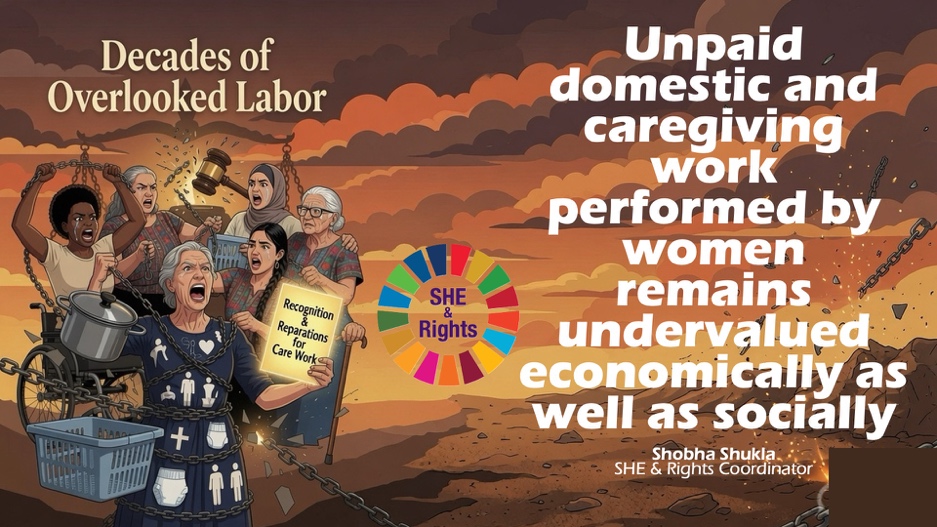
Unpaid domestic and caregiving work performed by women remains undervalued economically as well as socially.
This gender inequality is not genetic but created by patriarchy - every man has tasted the fruits of its entitlements. And every woman has borne its brunt in some form or the other. Patriarchy is a social system that normalises male dominance, entitlement, and control, and that devalues women, girls, and gender diverse peoples. The pressure to adjust, compromise, stay quiet, and ask for less - not because we women are incapable of more - but because we were taught to expect less since our early childhood. That's how evil inequality survives. And the moment women begin questioning these expectations, change begins. Let us not forget that change often starts with small refusals and not with big revolutions - like the Court refused to ignore the significance and value of unpaid domestic care work.
The Supreme Court has set the ball rolling, by recognising a woman’s worth, albeit, in this case, after her death. But recognition has to come within one's lifetime. Else all the plaudits by the Court will amount to lip service. In Hindi we have a proverb ‘जिए पर न दें कौरा, मरे पर झले चौरा’. This loosely translates into ‘starving someone to death when alive, but performing the last rites with fanfare.'
Women and girls deserve to be recognised to enjoy the fruits of their never-ending labour while they are still alive and not be put on a pedestal after their death.
What we need is a people centric feminist response that addresses patriarchal norms around masculinity, entitlement and control, And thanks once again to the Supreme Court for breaking the eerie silence and starting the conversation.
(Shobha Shukla is a feminist, health and development justice advocate, and an award-winning founding Managing Editor and Executive Director of CNS (Citizen News Service). She serves as Chairperson of Global AMR Media Alliance (GAMA), Host and Coordinator of SHE & Rights (Sexual Health with Equity & Rights), President of Asia Pacific Media Alliance for Health, Gender and Development Justice (APCAT Media), and founder leader of DJOP (Development Justice for Older Persons) initiative. She was also the Lead Discussant for SDG-3 at United Nations inter-governmental High Level Political Forum 2025. GAMA , led by her, received the AMR One Health Emerging Leaders and Outstanding Talents Award at UN High Level Ministerial Conference on AMR 2024. Follow her on X @shobha1shukla or read her writings here www.bit.ly/ShobhaShukla)
Following her death, her legal heirs - husband and children - filed a compensation claim before the Motor Accident Claims Tribunal (MACT). The Tribunal awarded a compensation of INR 2,42,000 (~US$ 2500) in December 2003. Not satisfied by this meagre amount the claimants filed an appeal in the High Court in 2004. The case was decided twenty years later at the fag-end of 2024 and a Single Judge enhanced the compensation to INR 8,43,400 (~US$ 8850) vide order dated 11th December 2024, along with 7.5% interest from the date of filing of the claim petition. It was further clarified that should the said payment be not made within three months, the rate of interest would be enhanced to 9% per annum and further if the amount is not paid within six months, enhancement shall be with interest at 12% per annum.
Still dissatisfied, the claimants approached the Supreme Court, contending that the lower courts had grossly undervalued the loss, and failed to adequately account for the full value of Reshma's domestic and caregiving contributions among other things.
In its landmark judgement delivered on 11th June 2026, the Court enhanced the compensation to INR 62,77,900 (~US$ 66,000), payable to the complainant by the respondent - insurance company.
The Supreme Court has earned laurels and accolades on two accounts for delivering this landmark judgement.
Loss of unpaid domestic care is a distinct economic loss
First and foremost the Court established that the loss of unpaid domestic care is a distinct economic loss, and ordered that a homemaker's work must be valued at a minimum of INR 30,000 (around USD 315) per month when calculating accident compensation. The Court further clarified that "this amount of INR 30,000 - i.e. loss of domestic care is to be taken as a 'stand- in' (basic minimum monthly income) for monthly income in those cases where the homemaker does not have an input into the house, in strictly conventional, monetary terms. In those cases where the homemaker is part of the workforce, the component of loss of domestic care shall be in addition to the monthly income as may be proved before the Tribunal/Courts."
Unpaid domestic and care work is economically undervalued
In their 36 pages judgement the Bench of Justice Karol and Justice Singh observed that homemakers, actually are the 'nation builders' and they ought to be recognised as such. The Court noted that unpaid domestic and caregiving work performed by women remains economically undervalued despite its enormous contribution to society and the economy.
In the Court’s view, "it is ironic to describe a homemaker as dependant on earning members, when, in reality the household’s functioning depends substantially on the homemaker. The earning members are in fact solely dependent on the homemaker but alas, this reality does not receive the acknowledgment it deserves."
The judgment also contains an extensive discussion on the social, emotional, economic and psychological contributions made by homemakers.
24 years delayed justice
The second important lacunae flagged by the Bench was the inordinate delay of 24 years in deciding the case. To assess the extent of the problem, the Bench examined precisely 123 appeals of Motor Accident Claims Tribunal decided by Supreme Court Benches headed by Justice Karol. The analysis revealed that the average pendency before Motor Accident Claims Tribunals was approximately six years, while appeals remained pending in High Courts for about eight years. So much for our Judiciary system.
"Although it is never possible to fully compensate for the loss of a person who has been an integral part of a person's family, the idea of just and fair compensation requires that an amount of money be paid to the claimants that would, as far as possible, place them in a position as if the unfortunate incident of the death of their loved one had not taken place. For whatever reason, when this takes twenty years, the suffering is only compounded further," the Bench observed.
Reshma’s soul must have had some respite after 24 years, for her family being compensated by the court for her unsung contribution to the family when she was alive.
The magnanimity of the Court notwithstanding, it is ironic that the importance of a woman's unpaid care work is acknowledged when she is no more. Do we need a fatal accident to establish her worth?
She deserves that acknowledgement while she is alive, even though it is difficult to assess such a contribution in monetary terms alone.
Unpaid domestic and caregiving work performed by women remains undervalued economically as well as socially.
This gender inequality is not genetic but created by patriarchy - every man has tasted the fruits of its entitlements. And every woman has borne its brunt in some form or the other. Patriarchy is a social system that normalises male dominance, entitlement, and control, and that devalues women, girls, and gender diverse peoples. The pressure to adjust, compromise, stay quiet, and ask for less - not because we women are incapable of more - but because we were taught to expect less since our early childhood. That's how evil inequality survives. And the moment women begin questioning these expectations, change begins. Let us not forget that change often starts with small refusals and not with big revolutions - like the Court refused to ignore the significance and value of unpaid domestic care work.
The Supreme Court has set the ball rolling, by recognising a woman’s worth, albeit, in this case, after her death. But recognition has to come within one's lifetime. Else all the plaudits by the Court will amount to lip service. In Hindi we have a proverb ‘जिए पर न दें कौरा, मरे पर झले चौरा’. This loosely translates into ‘starving someone to death when alive, but performing the last rites with fanfare.'
Women and girls deserve to be recognised to enjoy the fruits of their never-ending labour while they are still alive and not be put on a pedestal after their death.
What we need is a people centric feminist response that addresses patriarchal norms around masculinity, entitlement and control, And thanks once again to the Supreme Court for breaking the eerie silence and starting the conversation.
(Shobha Shukla is a feminist, health and development justice advocate, and an award-winning founding Managing Editor and Executive Director of CNS (Citizen News Service). She serves as Chairperson of Global AMR Media Alliance (GAMA), Host and Coordinator of SHE & Rights (Sexual Health with Equity & Rights), President of Asia Pacific Media Alliance for Health, Gender and Development Justice (APCAT Media), and founder leader of DJOP (Development Justice for Older Persons) initiative. She was also the Lead Discussant for SDG-3 at United Nations inter-governmental High Level Political Forum 2025. GAMA , led by her, received the AMR One Health Emerging Leaders and Outstanding Talents Award at UN High Level Ministerial Conference on AMR 2024. Follow her on X @shobha1shukla or read her writings here www.bit.ly/ShobhaShukla)
You May Also Like

Jammu and Kashmir has witnessed one of the longest and most painful chapters of terrorism and violence in the modern history of the region. The sit

Federal anti-terrorism command center, with a big screen and radar surveillance used for reconnaissance on satellite system.
Federal anti


PCP need your support that we may provide you better services: click on donate


"Trial of Pakistani Christian Nation" By Nazir S Bhatti
On demand of our readers, I have decided to release E-Book version of "Trial of Pakistani Christian Nation" on website of PCP which can also be viewed on website of Pakistan Christian Congress www.pakistanchristiancongress.org . You can read chapter wise by clicking tab on left handside of PDF format of E-Book.