
Sahiwal, Punjab: A 14-year-old Christian girl from Sahiwal was allegedly abducted and sexually assaulted after being forced into a room while colle
A Conversation at the United Nations: Listening, Learning and Remembering Kashmir Inbox. By Ghulam Nabi Fai
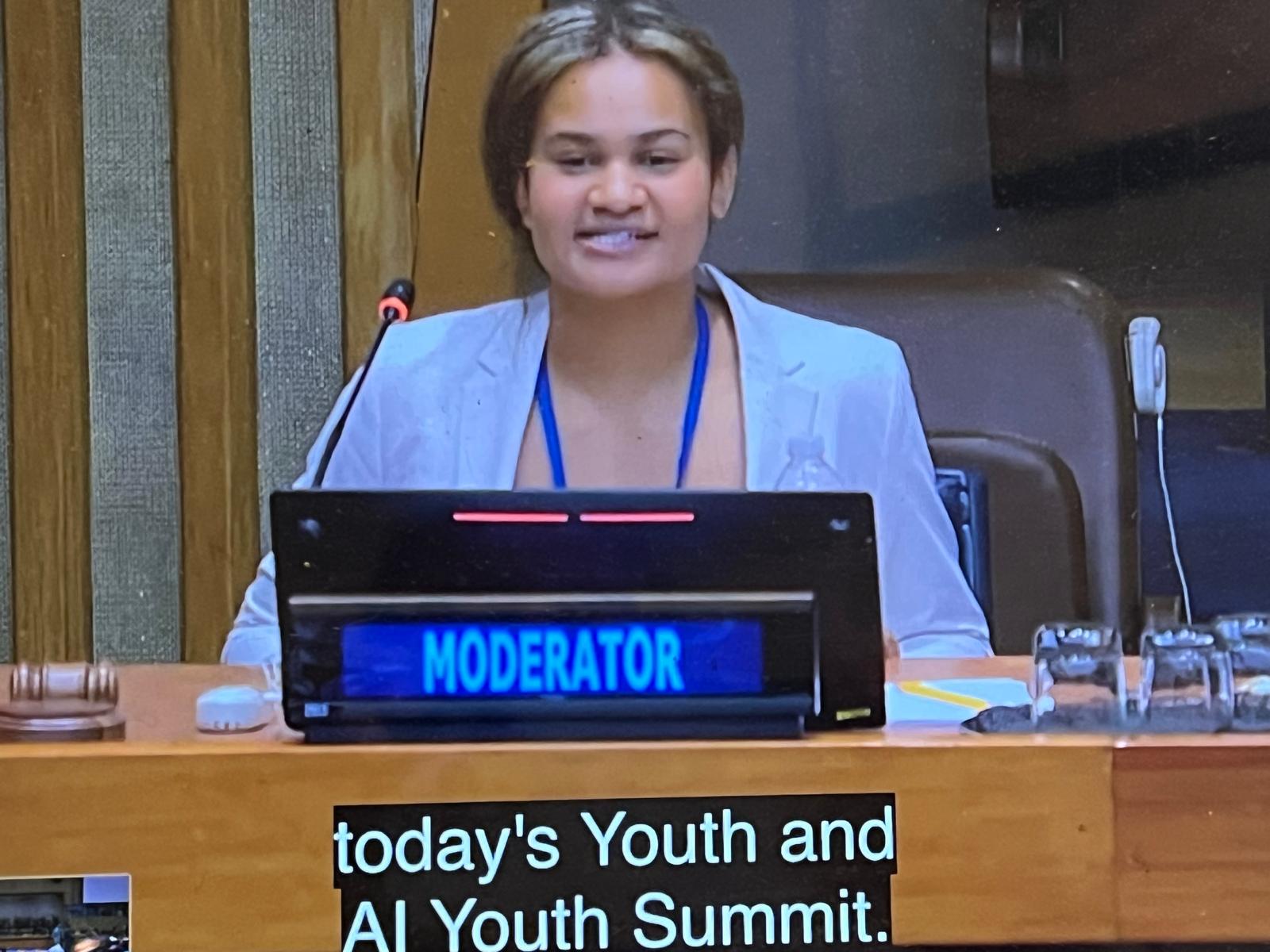
United Nations, Headquarters, New York: United Nations conferences are important not only because they bring together diplomats, international dignitaries and subject-matter experts, but also because they create opportunities for people from different backgrounds to listen to one another. For those of us participating through nongovernmental organizations, they can also provide opportunities to make interventions, submit written statements and, perhaps most importantly, build relationships that continue beyond the conference hall.
That is exactly what happened to me today, August 12, 2026, during the International Youth Day Celebration (IYDC) at United Nations Headquarters in New York.
IYDC began with an inspiring address delivered by Samara Lanham, a 19-year-old junior at UCLA and a dedicated member of the International Organization of Youth. Samara emphasized that young people are not simply the future of artificial intelligence governance—they are active participants in the conversation today. She highlighted the importance of youth voices, ideas, and experiences, affirming that their contributions matter and that there is a shared responsibility to help shape a future in which they wish to live.
While I intend to write a separate report about the IYDC, I want to share a particular encounter from the event—a pleasant experience I felt compelled to narrate, especially for the people of Kashmir which is my native country.
During the lunch break, I was standing in line at the UN cafeteria when a young college student looked at my conference badge.
“Hi, I am Vijay from Hartford, Connecticut,” he said. “Are you Dr. Fai?”
“Yes,” I replied. “How do you know me?”
“I don't,” he said with a smile. “I have never met you. I just saw your name on your badge. Would you mind if I sat with you? I am only getting a cup of coffee.”
“Of course not,” I said. I offered to get him a cup of coffee with my lunch, but he politely insisted on getting his own.
As we looked for a table, Vijay mentioned that two of his friends would like to join us. Soon, Seema from Boston and Anil from Vermont joined us. All three were young Americans of Kashmiri heritage who had come to attend the Youth celebration.
What followed was an unexpected and deeply meaningful conversation.
Vijay told me that his father, originally from Habba Kadal in Srinagar, had mentioned my name several times. I jokingly asked, “I hope not in a bad sense.”
“No, no,” he said. “There are some things I would like to discuss with you, if you don't mind.”
“Please feel free to ask anything,” I told him. “I will answer honestly to the best of my knowledge.”
The conversation soon turned to one of the most painful chapters in Kashmir's modern history: the displacement of Kashmiri Pandits from the Valley beginning around 1989–90.
Vijay said that his parents had told him that hundreds of thousands of Pandits had been forced to leave their homes and that Kashmiri Muslims had failed to protect them. He had heard many tragic stories and wanted to know what had actually happened.
Seema also wanted to understand the circumstances surrounding the exodus. Anil raised another question he had heard from his family: whether the homes of Pandits were subsequently destroyed or taken over by Muslims.
These were difficult questions. Yet I could see that they were not being asked in anger or with a political agenda. They were young people genuinely trying to understand a history that had been passed down to them through their families.
That distinction mattered.
Rather than respond with slogans, I suggested that we spend some time looking at historical accounts and different perspectives. It was about 1:30 p.m., and they were free until 3:00 p.m., so we had enough time for a serious conversation.
I began with an important qualification: I was not in Kashmir in 1989–90 and therefore could not present myself as an eyewitness. I told them that I knew people who had lived through those events, but that my own understanding was based on published accounts, testimonies and writings by people from different backgrounds.
I also emphasized something on which there should be little disagreement: whether one person or hundreds of thousands were displaced, the forced displacement of civilians from their homes is a profound human tragedy and a violation of fundamental human rights and particularly violation of Article 17 of UDHR.
How many Pandits left?
We discussed the numbers first. The number of Kashmiri Pandits who lived in the Valley before the mass displacement, and the number who subsequently left, has been the subject of considerable disagreement. Different sources and political narratives have produced widely different figures.
I told them that it was therefore important not to turn a disputed statistic into a measure of someone's suffering. Whether the number was closer to 150,000, 170,000, or another figure, the displacement of an entire community was a devastating event that deserves to be remembered honestly.
The tragedy does not become less serious because people disagree about the precise number.
What caused the exodus?
The question of why and how the Pandits left is equally complicated.
There were threats, fear, political instability and a deteriorating security environment. There are also differing accounts concerning the role of the administration under Governor Jagmohan and the circumstances in which Pandit families were encouraged or assisted to leave.
Some writers have argued that the administration's decisions contributed significantly to the exodus.
These accounts should not necessarily be treated as mutually exclusive. History can contain multiple forces operating simultaneously.
Most importantly, acknowledging the suffering of Kashmiri Pandits does not require assigning collective guilt to every Kashmiri Muslim. Likewise, acknowledging the experiences of Kashmiri Muslims during the conflict does not diminish the suffering experienced by Pandits.
What about Kashmiri Muslims?
This was perhaps the most sensitive part of our conversation. I told the students that Kashmir's history cannot fairly be reduced to a simple story of Hindus versus Muslims.
Kashmir has a long history of cultural and social interdependence. Families, neighborhoods and communities often lived alongside one another for generations. During the difficult years of conflict, there were also Muslims who protected Pandit neighbors, cared for their property, helped them leave, or hoped for their return.
At the same time, there were also Muslim civilians who themselves suffered displacement, killings and other abuses. None of these realities cancels the others.
One particularly important lesson is that communities should not be held collectively responsible for the actions of individuals, political leaders or governments.
I shared with the students historical accounts describing Muslim neighbors looking after Pandit homes and property after families departed. I also shared accounts of Muslims helping Pandits with funerals and other religious rites in more recent years.
I quoted George Fernandes, then the Federal Minister of India, who spoke at the Harvard University, Center for International Affairs on October 12, 1990 about the Hindu-Muslim co-existence in Kashmir. He said “I was last in Kashmir a fortnight back…One point which people constantly make and which, I believe, needs to be made is that the property houses, orchards owned by the Pandits have not been damaged in the last one year. The apples, for instance, from these orchards, have been plucked (by Muslim neighbors) and sold and the money has been deposited. The houses have been looked after as they were earlier by Muslim neighbors.” (Harvard U. Transcript page 8.)
I also quoted Sanjay Kak, an eminent and celebrated documentary filmmaker, and writer and a Kashmiri Pandit himself who explained, most Kashmiri Pandit families were not betrayed by their Muslim neighbours. While some properties were torched and destroyed, most temples and homes were not ransacked or looted, and many more have run to ruin over years of neglect.
These stories do not erase the darker chapters of Kashmir's history. But they remind us that compassion and solidarity survived even during periods of extraordinary division.
Kashmir's pluralistic heritage
I reminded the students of Mahatma Gandhi's famous observation about Kashmir in 1947: he saw in Kashmir a place where Hindu and Muslim Kashmiris shared language, culture and a common social heritage, and described Kashmir as a “ray of hope” at a time when communal violence was consuming much of the subcontinent.
Whether one approaches Kashmir's history through the lens of religion, nationalism, human rights or personal experience, that pluralistic heritage deserves to be remembered.
The stories of Kashmiri Pandits and Kashmiri Muslims should not be placed in competition with one another.
One community's pain does not invalidate another community's pain.
What can we say to the next generation?
As our conversation continued, I realized that Vijay, Seema and Anil were asking questions that many young people of Kashmiri heritage are asking today.
They have inherited memories from their parents and grandparents. Some have heard stories of displacement. Others have heard stories of coexistence. Some have heard narratives of victimhood, while others have heard narratives of political grievance.
Our responsibility is not to tell them what they must believe. Our responsibility is to give them the opportunity to examine history honestly, respectfully and without hatred.
The Kashmiri Pandit tragedy must be remembered. The suffering of Kashmiri Muslims must also be remembered. The experiences of Sikhs and other communities must not be forgotten. The failures of governments, the suffering of civilians and the acts of ordinary people who protected their neighbors all form part of a complicated history. A mature conversation about Kashmir must have room for all of these truths.
A message of hope
Before we left the cafeteria, I told these three young Americans something that I believe deeply: Kashmir belongs to all of its people.
Kashmiri Pandits should never be made to feel that their ancestral homeland is no longer theirs. They have every right to live in Kashmir with dignity, security and equality.
At the same time, the future cannot be built on collective blame. Kashmiri Muslims should not be treated as collectively responsible for the actions of militants or individuals, just as Kashmiri Pandits should not be defined solely by the suffering they endured. The goal should be neither denial nor accusation. The goal should be reconciliation.
Perhaps the most meaningful lesson from our unexpected lunch at the United Nations was that dialogue is possible when people are willing to listen before judging.
We may not agree on every number, every interpretation or every historical responsibility. But we can agree that displacement is tragic, violence against civilians is wrong, the demand of self-determination of the people of Kashmir is valid, human dignity is universal, and every community deserves to live without fear and
If the younger generation can approach Kashmir's history with curiosity rather than inherited hostility, perhaps they can help create the kind of society that earlier generations lost amid conflict.
The return of Kashmiri Pandits to a peaceful, secure and genuinely pluralistic Kashmir should not be viewed as a threat to anyone. It should be seen as an opportunity to restore something valuable that Kashmir once represented to the world: the possibility of communities living together with dignity, friendship and mutual respect.
That, ultimately, is the Kashmir we should strive to rebuild.
(Dr. Ghulam Nabi Fai can be reached at: WhatsApp: 1-202-607-6435 gnfai2003@yahoo.com)
You May Also Like
USA: Declaring Jammu and Kashmir an integral part of India does not resolve the dispute or address the aspirations of its people. A peaceful, negot
Pakistan: Christian brothers Qaiser and Amoon Ayub were sentenced to death in 2018 over allegations of online blasphemy. On 7 October 2026, the Sup


PCP need your support that we may provide you better services: click on donate


"Trial of Pakistani Christian Nation" By Nazir S Bhatti
On demand of our readers, I have decided to release E-Book version of "Trial of Pakistani Christian Nation" on website of PCP which can also be viewed on website of Pakistan Christian Congress www.pakistanchristiancongress.org . You can read chapter wise by clicking tab on left handside of PDF format of E-Book.