
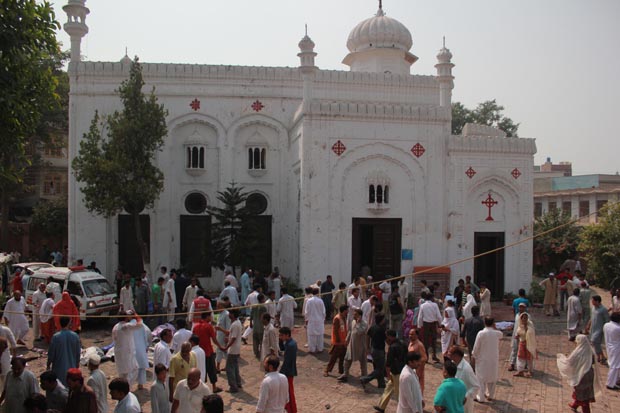
LAHORE, PUNJAB: Pakistan’s history of terrorist attacks against Christians and Christian places of worship has raised continuing concerns abo
Religious minorities in Iran still at risk despite new human rights charter, warns Global Minorities Alliance

Scotland: December 16, 2013. (PCP) A Glasgow-based human rights organisation is calling upon the President of Iran to extend protections to minority religions in his upcoming Charter of Citizens’ Rights, following the religiously motivated murder of a member of the Baha’i community.
Global Minorities Alliance (GMA), which fights for the rights of minority groups the world over, condemns the continued persecution of minority religions in Iran, both in law and on the streets, which led to the death of Ataollah Rezvani this summer.
Although the new Charter of Citizens’ Rights is being heralded as a step forward by the Iranian government, GMA believes it to be a toothless move which will offer no further protection to minority religions as it will not reform the laws which already legally persecute minority communities such as the Baha’i community.
Iranian president Hassan Rouhani released a draft Charter of Citizens’ Rights on 26 November 2013, 100 days into his presidency. The President is said to have consulted around 200 experts, academics, activists and religious figures prior to releasing it, and has now given others a month to send in their comments so that it can be revised before the final version is released.
The President’s aim was for citizens’ rights to make ‘all Iranians feel they are part of one nation, one identity, under one umbrella they can feel proud of’, and insisted that it was something the government is taking seriously rather than just a political gesture.
The Charter will not have an effect on existing rights, laws, obligations or international conventions, and will not create new rights or obligations. It is, instead, said to be a declaration of how Iran understands citizens’ rights and how it will prioritise them in its activities.
Elham Aminzadeh, Iran’s Vice President for Legal Affairs, says the Charter ‘draws a clear image of the rights of citizens, which are dispersed in a large number of laws, and opens the door for them to be acquainted clearly and in writing with their political, legal, economic, cultural and social rights.’
However, Nazila Ghanea, who teaches international human rights law at the University of Oxford, believes that this may lead to other human rights obligations – such as international human rights treaties from bodies such as the UN – being overshadowed.
Although the Charter provides for disability rights, elderly rights, group rights and the environment (and makes repeated references to ethnic/linguistic/Islamic diversities and minorities), it continues to overlook wider religious freedom. As the Charter has to be understood ‘within the framework of the law’ and with ‘due consideration to Islam’, or as outlined in the Iranian Constitution, then the only recognised religious minorities will continue to be Christians, Zoroastrians and Jews.
“That purposeful exclusion of the largest non-Muslim religious minority community in Iran, the Baha’is, is extended and entrenched further in this rights Charter,” says Ghanea in her commentary on the new Charter, which points out that as Baha’is are not recognised by law, discrimination will remain legitimate.
“Another reading of the Iranian Citizens’ Charter is, therefore, that – by way of example – Baha’is in Iran are to not enjoy: freedom of thought and expression, identity, non-discrimination, the protection of their historical and cultural sites and monuments, parental rights, minority rights and religious freedoms.”
The Charter has been released less than six months after the murder of Ataollah Rezvani, who was shot in the head on the outskirts of the city of Bandar Abbas in August this year. According to the Baha’i World News Service:
“Mr. Rezvani was well-known as a Baha'i and was loved and respected by the people of Bandar Abbas for his honesty and helpfulness. As a young man, he was expelled from his engineering studies at university because he was a Baha'i. He nonetheless came to be regarded as an expert in water purification, and his work took him to other cities.
“Recently, owing to pressure and threats from agents of the Ministry of Intelligence, he was dismissed from his work and had to resort to selling water purification equipment. These agents had also been bringing pressure to bear on him to leave the city. More recently, he had begun receiving menacing telephone calls from unknown persons.”
The Baha’i World News Service points out that senior local clerics have attempted to incite violence against the Baha’i community in recent years through incendiary sermons against Baha’is in Bandar Abbas.
Shahid Khan, GMA’s Vice-Chairperson, urges the Iranian government to act now to adjust the Charter, expanding its human rights protection to groups like the Baha’is:
“Although the draft Charter of Citizens’ Rights can be seen as a step forward in terms of human rights in Iran, human rights need to cover all individuals and not only those deemed ‘legal’ by discriminatory legislation.
“If the Iranian government is not protecting all minorities, religious as well as linguistic and ethnic, then how can this be seen as a Charter to make all Iranians feel part of the same nation? The Baha’is of Iran are just as Iranian as any other group and should therefore be included in the Charter. Until then this is a document that the Iranian President should not feel proud of. Religiously-motivated murders will be allowed to continue if the rights of minority groups continue to be overlooked.
“GMA has been working closely with the Baha’i community in the UK and we have received communications from individuals who strongly expressed their concerns about the recent moves to protect ‘rights’ by the Iranian government. And with the religiously motivated murder of Baha’is continuing in the country and Baha’is continuing to be seen as ‘non-citizens’ in the draft Charter, it is easy to see why.”
As well as the recent murder, unduly harsh prison sentences have been handed down to leaders of the Baha’i community in recent years, such as the 20-year sentences handed to seven Baha’i leaders in 2008. Christian converts are also subject to unduly harsh sentences for practising their religion, such as the Iranian American Christian pastor Saeed Abedini, who has been sentenced to eight years in prison for his Christian evangelical activities in Iran.
“GMA condemns these prison sentences and demands the release of religious prisoners,” says Khan. “If the Charter is a new focus on human rights by the Iranian government then perhaps some past injustices should be reconsidered.”
The Iranian government now seeks comments on its draft from groups such as universities, unions, and groups concerned with the environment, political and journalistic freedoms, before the Charter is referred to the parliament.
With less than two weeks to go for comments to be submitted, GMA hopes that the Iranian President will look to expand the Charter to include religious minorities to help to stop religiously-motivated crimes like the murder of Ataollah Rezvani from happening in the future.
You May Also Like
UK: RAAC homeowners in Tillicoultry are formally complaining to Clackmannanshire Council after continuing uncertainty over VAT, financial assistanc
KAMOKE, PUNJAB: Calls for truth, transparency and accountability are growing following the death of David Masih, a young Christian man from Kamoke


PCP need your support that we may provide you better services: click on donate


"Trial of Pakistani Christian Nation" By Nazir S Bhatti
On demand of our readers, I have decided to release E-Book version of "Trial of Pakistani Christian Nation" on website of PCP which can also be viewed on website of Pakistan Christian Congress www.pakistanchristiancongress.org . You can read chapter wise by clicking tab on left handside of PDF format of E-Book.