
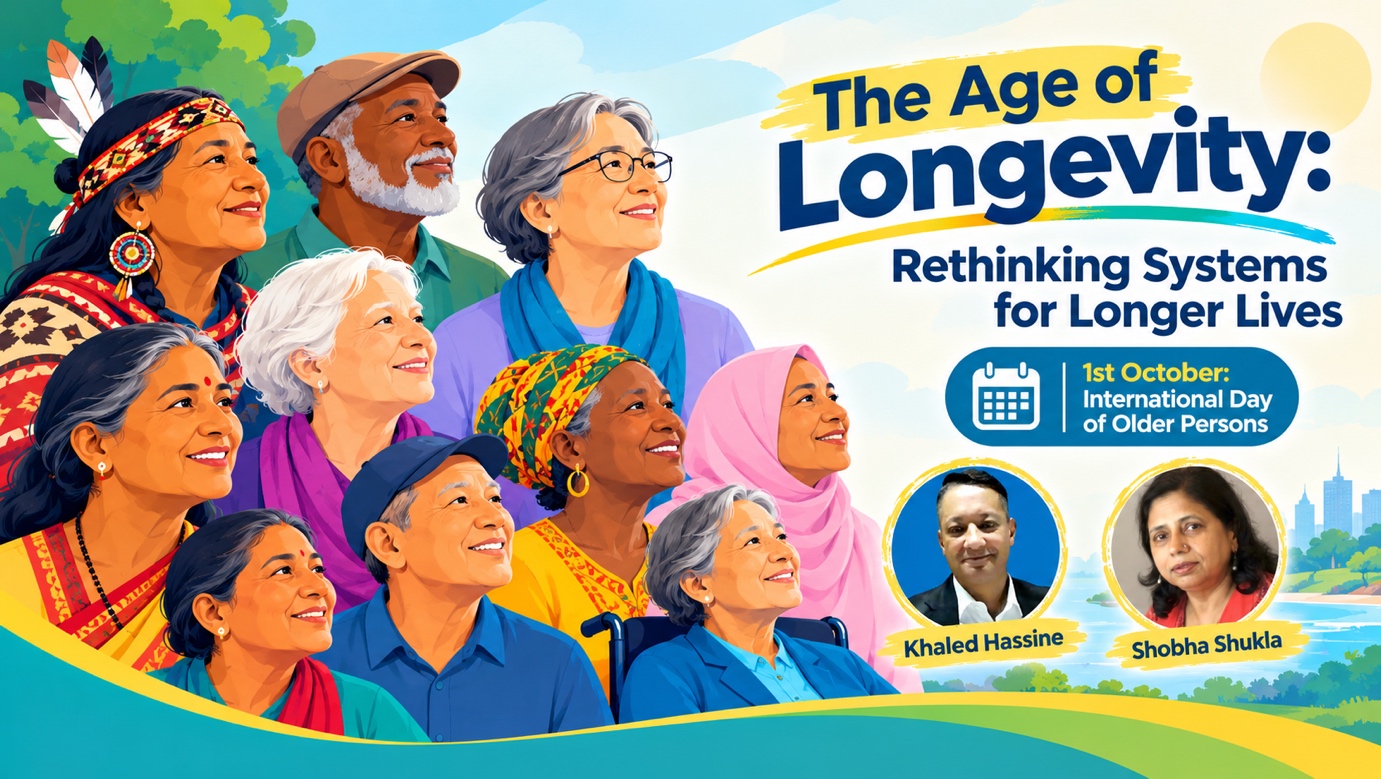
October 2026 may mark a pivotal moment in the global fight for equality and human rights for older persons. On 1st October the world observes the I
Would global ministerial meet galvanise action to prevent AMR in humans, animals, plants and environment? By SHOBHA SHUKLA
High level ministerial delegations from over 100 countries (mostly from the Global South) are expected to converge in Nigeria this June to attend the 5th High Level Ministerial Meeting on Antimicrobial Resistance (AMR) that will be held on the African soil for the first time in history, with the Nigerian government hosting it.
The past meetings were held in Netherlands (twice) followed by Oman and Saudi Arabia - all high-income countries. AMR is a critical crisis impacting health and food security in low- and middle-income countries. It is for the first time that this upcoming meet is being held in a low- and middle-income country (Nigeria) - which gives hope for spurring more relevant actions to prevent AMR.
AMR or drug resistance is among the top 10 global health threats and threatens our livestock, food systems, economies and our environment. It is a problem driven by misuse and overuse of antimicrobial medicines - including antibiotics, antivirals, antiparasitics and antifungals - and results in critical medicines losing their effectiveness to treat infections. As a result of drug resistance, medicines become ineffective, and infections become increasingly difficult or impossible to treat.
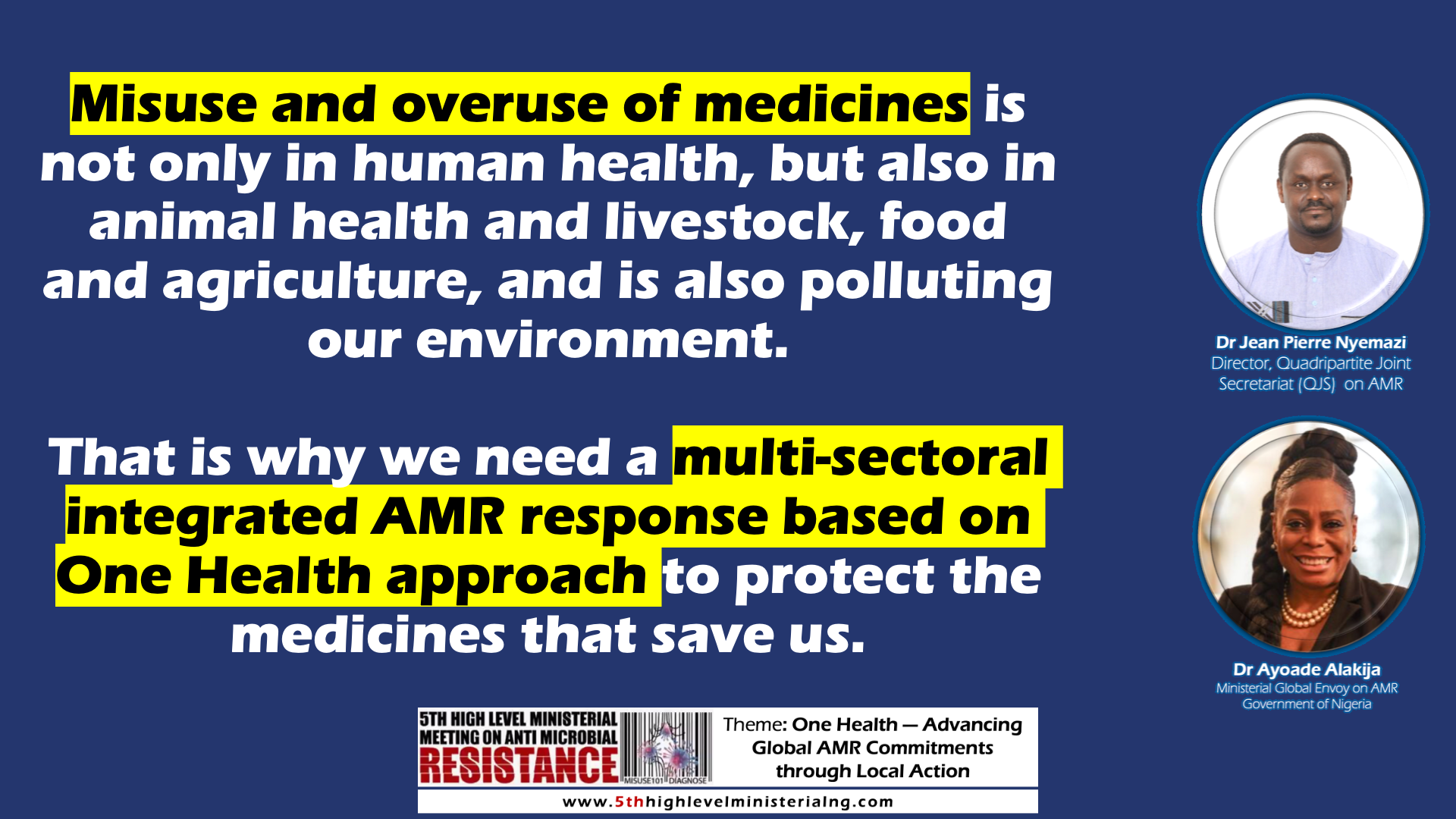
Misuse and overuse of medicines is not only rampant in human health, but also in animal health and livestock, food and agriculture, and is also polluting our environment.
That is why global lead agencies on human health (World Health Organization - WHO), environment (United Nations Environment Programme - UNEP), food (Food and Agriculture Organization of the United Nations - FAO) and animal health (World Organisation for Animal Health - WOAH) united to form Quadripartite Joint Secretariat on AMR to address the challenge with One Health approach. All Quadripartite agencies are supporting this upcoming global ministerial meeting on AMR.
Translate political commitments into country-level delivery
"The 5th High Level Ministerial Meeting on AMR is a key moment to carry forward the momentum from UN General Assembly High Level Meeting on AMR 2024, as well as to translate the political commitments made there into country-level delivery. This upcoming meeting also builds upon the Jeddah commitments made at the 4th High Level Ministerial Meeting on AMR hosted by Saudi Arabia in 2024”, said Dr Jean Pierre Nyemazi, Director of Quadripartite Joint Secretariat on AMR.
"In Jeddah, we agreed on Troika mechanism to keep continuity from one meeting to another. So, past discussions held at 4th High Level Ministerial Meeting on AMR in Jeddah in 2024 are informing the organising of 5th Meeting in Nigeria in 2026”, he added.
The Troika of Jeddah was designed to maintain momentum between ministerial meetings.
Agrees Dr Ayoade Alakija, Ministerial Global Envoy on AMR, Government of Nigeria, that the Troika mechanism is ensuring continuity and accountability and is helping institutionalise governance of AMR mechanisms across countries, regions and globally.
Dr Nyemazi and Dr Alakija were addressing an exclusive Global Media Briefing organised by Global AMR Media Alliance (GAMA), Nigeria AMR Media Alliance (NAMA) and other national and sub-national GAMA chapters ahead of the 5th High Level Ministerial Meeting on AMR.
Multisectoral implementation of multisectoral AMR action plans
“The task for this upcoming 5th High Level Ministerial Meeting on AMR in Nigeria would be to enable the acceleration of implementation of multi-sectoral national action plans on AMR, enabled by effective governance at all levels, sustainable investment at all levels, and walking the talk on the theme of One Health for advancing global AMR commitments through local actions”, said Dr Nyemazi.
Reducing AMR deaths through One Health Approach
One of the targets of the Political Declaration adopted at the UN General Assembly High Level Meeting on AMR in 2024 was to reduce AMR deaths by 10% by 2030 (compared to 4.9 million AMR associated deaths recorded in 2019).
The focus is changing from human health to One Health approach.
“AMR is not just about human health and protecting just our medicines. It is also about prevention and protecting our animals, plants and our environment. We need to ensure that not only humans are not harmed due to AMR but also our animals, agriculture and food systems and our environment are kept safe so that we all can live in harmony together,” said Dr Alakija.
Agrees Dr Nyemazi that when we talk about AMR prevention, it is about preventing AMR across all the sectors - food and agriculture, livestock, environment - and not just in human health sector.
Keeping this One Health approach in mind, the Nigerian government has invited not just ministers of health, but also ministers of agriculture, environment and finance of all other countries to participate in the 5th High Level Ministerial Meeting on AMR to collectively address the problem of AMR in all sectors (such as livestock, food and agriculture and environment) and of course human health sector.
Investing in AMR control makes economic sense
If we invest USD 1 on AMR, return on investment is USD 11, says Dr Alakija. “This upcoming 5th High Level Meeting in Nigeria would focus more on solutions to address the challenge AMR is posing. We also need to ensure that AMR response is fully financed, including prevention, surveillance, water, sanitation and hygiene. It is strategic investments that our countries and our communities need, so it is important to involve Ministries of Finance as well”, she added. She hopes that the upcoming meeting will also play a historic role in sustainable financing for AMR response, just like the Abuja Declaration of 2001 where African countries committed to invest 15% of their annual budgets on health”.
We need an integrated response to tackle AMR
It is important for all sectors to work in concert with one another. "AMR has typically been seen often from the lens of high-income countries. We need to address AMR recognising the gaps and contexts in especially low- and middle-income countries – and ways to bridge the gaps in prevention of infectious diseases as well as gaps in stopping misuse and overuse of medicines in food and agriculture sector, animal health sector and environment along with human health sector. AMR commitments, like the UN General Assembly High Level Meeting's Political Declaration 2024, needs to be translated into not just actions but local actions which are critical," said Dr Alakija.
For her the larger objective is to advance and to sustain global efforts to curb AMR in Nigeria, Africa and globally, and rightly so.
Both Dr Nyemazi and Dr Alakija agree that media is a strategic partner in AMR response to inform, connect and hold governments accountable. Evidence-based reporting ensures that AMR is visible as a development, equity and sustainability issue, it shapes public understanding, support, behaviour change, and sustains pressure for measurable progress. Media is critical not only for accountability but also for awareness, and keeping the communities we serve involved as partners in the efforts to control AMR.
We need an equitable AMR response
All of us are at risk of AMR. But in the absence of strong public systems, those in low- and middle-income countries – and especially those who are underserved - are at a much-heightened risk of AMR. We have to do better in protecting the medicines that save us. We also have to do better in saving lives from preventable infections as well as ensuring right and timely diagnosis and right treatment, care and support for everyone, leaving no one behind.
(Shobha Shukla is a feminist, health and development justice advocate, and an award-winning founding Managing Editor and Executive Director of CNS (Citizen News Service). She serves as Chairperson of Global AMR Media Alliance (GAMA), Host and Coordinator of SHE & Rights (Sexual Health with Equity & Rights), President of Asia Pacific Media Alliance for Health, Gender and Development Justice (APCAT Media), and founder leader of DJOP (Development Justice for Older Persons) initiative. She was also the Lead Discussant for SDG-3 at United Nations inter-governmental High Level Political Forum 2025. GAMA , led by her, received the AMR One Health Emerging Leaders and Outstanding Talents Award at UN High Level Ministerial Conference on AMR 2024. Follow her on X @shobha1shukla or read her writings here www.bit.ly/ShobhaShukla)
The past meetings were held in Netherlands (twice) followed by Oman and Saudi Arabia - all high-income countries. AMR is a critical crisis impacting health and food security in low- and middle-income countries. It is for the first time that this upcoming meet is being held in a low- and middle-income country (Nigeria) - which gives hope for spurring more relevant actions to prevent AMR.
AMR or drug resistance is among the top 10 global health threats and threatens our livestock, food systems, economies and our environment. It is a problem driven by misuse and overuse of antimicrobial medicines - including antibiotics, antivirals, antiparasitics and antifungals - and results in critical medicines losing their effectiveness to treat infections. As a result of drug resistance, medicines become ineffective, and infections become increasingly difficult or impossible to treat.
Misuse and overuse of medicines is not only rampant in human health, but also in animal health and livestock, food and agriculture, and is also polluting our environment.
That is why global lead agencies on human health (World Health Organization - WHO), environment (United Nations Environment Programme - UNEP), food (Food and Agriculture Organization of the United Nations - FAO) and animal health (World Organisation for Animal Health - WOAH) united to form Quadripartite Joint Secretariat on AMR to address the challenge with One Health approach. All Quadripartite agencies are supporting this upcoming global ministerial meeting on AMR.
Translate political commitments into country-level delivery
"The 5th High Level Ministerial Meeting on AMR is a key moment to carry forward the momentum from UN General Assembly High Level Meeting on AMR 2024, as well as to translate the political commitments made there into country-level delivery. This upcoming meeting also builds upon the Jeddah commitments made at the 4th High Level Ministerial Meeting on AMR hosted by Saudi Arabia in 2024”, said Dr Jean Pierre Nyemazi, Director of Quadripartite Joint Secretariat on AMR.
"In Jeddah, we agreed on Troika mechanism to keep continuity from one meeting to another. So, past discussions held at 4th High Level Ministerial Meeting on AMR in Jeddah in 2024 are informing the organising of 5th Meeting in Nigeria in 2026”, he added.
The Troika of Jeddah was designed to maintain momentum between ministerial meetings.
Agrees Dr Ayoade Alakija, Ministerial Global Envoy on AMR, Government of Nigeria, that the Troika mechanism is ensuring continuity and accountability and is helping institutionalise governance of AMR mechanisms across countries, regions and globally.
Dr Nyemazi and Dr Alakija were addressing an exclusive Global Media Briefing organised by Global AMR Media Alliance (GAMA), Nigeria AMR Media Alliance (NAMA) and other national and sub-national GAMA chapters ahead of the 5th High Level Ministerial Meeting on AMR.
Multisectoral implementation of multisectoral AMR action plans
“The task for this upcoming 5th High Level Ministerial Meeting on AMR in Nigeria would be to enable the acceleration of implementation of multi-sectoral national action plans on AMR, enabled by effective governance at all levels, sustainable investment at all levels, and walking the talk on the theme of One Health for advancing global AMR commitments through local actions”, said Dr Nyemazi.
Reducing AMR deaths through One Health Approach
One of the targets of the Political Declaration adopted at the UN General Assembly High Level Meeting on AMR in 2024 was to reduce AMR deaths by 10% by 2030 (compared to 4.9 million AMR associated deaths recorded in 2019).
The focus is changing from human health to One Health approach.
“AMR is not just about human health and protecting just our medicines. It is also about prevention and protecting our animals, plants and our environment. We need to ensure that not only humans are not harmed due to AMR but also our animals, agriculture and food systems and our environment are kept safe so that we all can live in harmony together,” said Dr Alakija.
Agrees Dr Nyemazi that when we talk about AMR prevention, it is about preventing AMR across all the sectors - food and agriculture, livestock, environment - and not just in human health sector.
Keeping this One Health approach in mind, the Nigerian government has invited not just ministers of health, but also ministers of agriculture, environment and finance of all other countries to participate in the 5th High Level Ministerial Meeting on AMR to collectively address the problem of AMR in all sectors (such as livestock, food and agriculture and environment) and of course human health sector.
Investing in AMR control makes economic sense
If we invest USD 1 on AMR, return on investment is USD 11, says Dr Alakija. “This upcoming 5th High Level Meeting in Nigeria would focus more on solutions to address the challenge AMR is posing. We also need to ensure that AMR response is fully financed, including prevention, surveillance, water, sanitation and hygiene. It is strategic investments that our countries and our communities need, so it is important to involve Ministries of Finance as well”, she added. She hopes that the upcoming meeting will also play a historic role in sustainable financing for AMR response, just like the Abuja Declaration of 2001 where African countries committed to invest 15% of their annual budgets on health”.
We need an integrated response to tackle AMR
It is important for all sectors to work in concert with one another. "AMR has typically been seen often from the lens of high-income countries. We need to address AMR recognising the gaps and contexts in especially low- and middle-income countries – and ways to bridge the gaps in prevention of infectious diseases as well as gaps in stopping misuse and overuse of medicines in food and agriculture sector, animal health sector and environment along with human health sector. AMR commitments, like the UN General Assembly High Level Meeting's Political Declaration 2024, needs to be translated into not just actions but local actions which are critical," said Dr Alakija.
For her the larger objective is to advance and to sustain global efforts to curb AMR in Nigeria, Africa and globally, and rightly so.
Both Dr Nyemazi and Dr Alakija agree that media is a strategic partner in AMR response to inform, connect and hold governments accountable. Evidence-based reporting ensures that AMR is visible as a development, equity and sustainability issue, it shapes public understanding, support, behaviour change, and sustains pressure for measurable progress. Media is critical not only for accountability but also for awareness, and keeping the communities we serve involved as partners in the efforts to control AMR.
We need an equitable AMR response
All of us are at risk of AMR. But in the absence of strong public systems, those in low- and middle-income countries – and especially those who are underserved - are at a much-heightened risk of AMR. We have to do better in protecting the medicines that save us. We also have to do better in saving lives from preventable infections as well as ensuring right and timely diagnosis and right treatment, care and support for everyone, leaving no one behind.
(Shobha Shukla is a feminist, health and development justice advocate, and an award-winning founding Managing Editor and Executive Director of CNS (Citizen News Service). She serves as Chairperson of Global AMR Media Alliance (GAMA), Host and Coordinator of SHE & Rights (Sexual Health with Equity & Rights), President of Asia Pacific Media Alliance for Health, Gender and Development Justice (APCAT Media), and founder leader of DJOP (Development Justice for Older Persons) initiative. She was also the Lead Discussant for SDG-3 at United Nations inter-governmental High Level Political Forum 2025. GAMA , led by her, received the AMR One Health Emerging Leaders and Outstanding Talents Award at UN High Level Ministerial Conference on AMR 2024. Follow her on X @shobha1shukla or read her writings here www.bit.ly/ShobhaShukla)
You May Also Like

Jammu and Kashmir has witnessed one of the longest and most painful chapters of terrorism and violence in the modern history of the region. The sit

Federal anti-terrorism command center, with a big screen and radar surveillance used for reconnaissance on satellite system.
Federal anti


PCP need your support that we may provide you better services: click on donate


"Trial of Pakistani Christian Nation" By Nazir S Bhatti
On demand of our readers, I have decided to release E-Book version of "Trial of Pakistani Christian Nation" on website of PCP which can also be viewed on website of Pakistan Christian Congress www.pakistanchristiancongress.org . You can read chapter wise by clicking tab on left handside of PDF format of E-Book.